Reviews & articles for shooting sport enthusiasts.

Latest

How to make a better revolver? Is it even possible?

Rhino_Prototype

The original prototype Rhino. Ghisoni’s final engineering design.

Those who have frequented TPF-Online may have read about the extremely interesting Mateba 6-Unica. The “Auto-Revolver” designed by Emilio Ghisoni, was an extremely technical work of engineering and while the marketability of the “Mateba” may have been questionable, the fact that the design was something completely new, and born of imagination, only lends to confirm his engineering knowledge and creativity. The driving goal of nearly all of Mr. Ghisoni’s designs was for faster and more accurate subsequent shots on a target. To that effect, managing recoil and muzzle flip permeate every single firearms related patent, which has Mr. Ghisoni’s name associated to it. Unfortunately, Mr. Ghisoni passed away in April of 2008, but not before designing what may be revolutionary in terms of design excellence. However, you will need to read further and be the judge of that.

Chiappa Rhino Revolver Patent

The Rhino’s patent shows the uncommon inner workings compared to traditional revolver designs.

Macchine Termo-Balistiche (Ma.Te.Ba), was sold by mid-2000 and included in the sale were all the previous patent rights for the Unica-6 and other firearm designs founded under Ghisoni’s former company brand name. In the summer of 2000, the company Thermoballistic Machines di Emilio Ghisoni (aka The.ma), began manufacturing of food industry products for Italy. However, whether it was a personal passion for firearms or the quest for technical excellence in design, Emilio Ghisoni continued to work on innovative firearm layouts. With the assistance of Mr. Antonio Cudazzo, financial backing, product evolution and design were possible. It was through a series of back and forth ideas between technical design and ergonomic form that evolved into the Rhino design. While the ergonomics of the Rhino were due to the concepts from Mister Cudazzo, Mister Ghisoni was the source of engineering ability to design the inner workings and functionality of a reliable firearm in such a condensed package.

Working concept

Serial number 000003A. One of the initial working versions manufactured by The*Ma

In the year 2003, The.ma debuted a model prototype six (6) shot revolver chambered in .357 Magnum, which featured a short 50mm (2″) barrel and an extremely narrow profile. The truly interesting feature, and now almost a trademark for Mr. Ghisoni designs, was that the revolver fired from the six o’clock position on the cylinder. This small revolver was known as the The.Ma Rhino revolver. By 2006, Thermoballistic Machines had created a handful of working versions which, akin to previous projects, were effectively all a series of work in progress stages of the Rhino. As with the “Mateba” however, manufacturing was done, by what amounted to a custom machine shop and, as such, the larger scale production requirements were still being adapted in the design.

Unfortunately, the extreme divergence of the Rhino’s design compared to traditional revolvers made many firearms companies in Italy hesitant, if not completely against, endorsing the design for mass production. It was not until after Mr. Ghisoni’s passing that Mr. Cudazzo met with Reno Chiappa (pronounced ‘ki-appa’) who recognized the potential in the design. As proprietor of the Chiappa Group, Mr. Chiappa saw the 50mm (2”) revolver and saw the designs best market being in North America, specifically the United States. Contacting Ron Norton, president of Chiappa Firearms Ltd., in the USA, Reno presented the design for marketing and design adjustments for mass production tweaking. In 2009 the first production models were introduced and to this day the Rhino continues to evolve with customer feedback and market requests.

Rhino1

The Chiappa Rhino 50DS as recieved by TPF Online

From Chiappa’s introduction of the Rhino back in 2009 it was obvious that the design was completely alien to common concepts of revolvers. The title statement from the 2009 catalogue was simple and to the point:

A revolver is a repeating firearm that consists of multiple chambers and at least one barrel for firing. As the user cocks the hammer, the cylinder revolves to align the next round with the barrel, which gives this type of firearm its name. In modern revolvers, the revolving cylinder typically chambers 5 or 6 rounds. And that is where the similarity ends.

Similar

The concept is not new, The Russian AEK-906 proves that. The Rhino goes further however…

The biggest difference is the barrel position which is mounted so the bottom most chamber of the cylinder is aligned with the barrel axis. That is a complete flip from traditional revolvers. Yes, there is one or two similar concept designs, such as the Russian AEK-906, but in general the orientation is nearly unheard of outside of firearms designed Mr. Ghisoni. Some of the traditional revolver designs characteristics were ignored to accommodate to accommodate the compact design profile dreamed up by Mr. Cuzzado. His initial wax model helped Mr. Ghisoni to engineer new mechanisms and concepts that would lead into the Rhino being made by Chiappa. A traditional revolver has a hammer located above the revolver’s grip and a trigger that resides near the back edge of the cylinder. With the inverted barrel design and a goal for reduced size and profile, the Rhino’s hammer resides inside the grip area of the revolver and the trigger is positions mid-cylinder. With such a radical change in grip and trigger placement, the Rhino is significantly smaller than a comparable traditional revolver. The 50mm (2.0”) barrel version of the Rhino is less than 165mm (6.5”) long overall, compared to a Smith & Wesson 327 of similar barrel length, which is roughly 180mm (7.1”) in length. There have been several changes since the initial release of the Rhino way back in 2009 and TPF will hopefully cover all of them in this review.

Showing the LS

It looks bulky and square and then you realize that the barrel is on the bottom….

The results of throwing out tradition? TPF does a review of a Rhino 50DS to find out.

Model: Chiappa Rhino 50DS Revolver
Finish: Matte Black
Calibre: .357 Remington Magnum
Capacity: Six (6)
Barrel: 127mm (5”)
Mass (Empty): 895g (31.6oz)
Grips: Walnut

Appearances:
Like its predecessor, the “Mateba”, the Rhino design is one that can be considered ugly when compared to traditional designs. However, beauty is in the eye of the beholder and everyone has his or her own opinion. The reviewed Rhino was a black finish 50DS model, which stands for 5.0” barrel and Double/Single action. Currently there is a double action only version available but only in 50mm (2”) barrel configurations. The original version of this Rhino, as initially reviewed, had a plain front sight post and a target rear sight, which was adjustable for windage and elevation. The faux “hammer” on the Rhino is simply a cocking lever, as the internal hammer is connected via a floating bar, meaning that in double action shooting the cocking lever stays immobile while the hammer is cocked and released via the trigger mechanics. An interesting feature is the cocked hammer indicator pin that extends roughly 3mm (0.12”) from the frame of the Rhino when the hammer is in the cocked position.

Ready to shoot?

Hammer down (L) versus cocked (R), the indicator pin is almost a requirement due to the internal hammer

Rhino-CraneArm

Oddly shaped to wrap around the lower barrel, the crane arm is detented to ensure a solid locked position

A hexagonal cylinder makes for a thinner profile and supposedly is better for concealment and comfort for those regions/markets where concealed carry weapon permits are available. The cylinder release is completely alien to modern revolvers being a rotating lever co-axial with the cocking lever. The crane arm swings out just as a regular revolver but there is a spring-loaded ball detent to ensure positive closure and assist in cylinder alignment/lockup. All the newest models of the Rhino sport fibre optic front sights compared to a simple blade sight. Rear target sights, adjustable for windage and elevation, are standard on the 102mm & 127mm (4” & 5”) Rhino’s and the 152mm (6”) version has a fibre optic enhanced version. The 50mm (2”) barrel version has a slight variation that utilizes a notched cocking lever for a fixed rear sight. The 102mm (4”) and longer versions of the Rhino incorporate a Picatinny rail under the barrel for mounting tactical accessories and the longest Rhino has an additional rail up top for optic mounting. These features add to the apparent bulk of the Rhino.

Rhino-underbarrel

At the 6 O’Clock position, the barrel is very low compared to traditional revolvers

There are two available finishes to the Rhino, Black and White; with the black being a matte finish and the white being close to a brushed stainless steel colouration. The reviewed Rhino does strike an interesting change in appearance when compared to similar sized traditional revolvers. With several cutouts along the barrel shroud, the Rhino is very light in mass despite the bulky frame. Aesthetic curving lines and sweeping radii are not a part of the design profile unless you include the grip. However, the angular features and slab-like sides create a particularly fierce and futuristic look to the firearm.

 Physical Size and Handling:

Rhino_cylinder

A very small profile, hexagonal cylinder with a post style ratchet.

The very first thing to note is that the Rhino is roughly 10-15mm shorter than any comparable modern revolver. Additionally, due to the grip position the firearm also has a shorter height than most other revolvers. From a bulk perspective, the grip area and cylinder occupy less space whereas the lower barrel position requires the inclusion of an elevated rail for sight alignment easily doubles that of revolvers that have a full-length under barrel lug. When gripping the Rhino, the first thing that is noticed is the enhanced grip angle is similar to that of Styer M9s, however the smooth, curving heel coupled with the huge “Beaver Tail” included in part of the one piece grip make holding the Rhino very comfortable. The shooter’s grip is extremely high on the firearm and as a result, the lower barrel axis is extremely close to the arm’s centerline. Held as per instructions, the Rhino seems to point very naturally with one hand.

The bulk of the gun belies the lack of mass when the Rhino is actually hefted. This is due to the shrouded style barrel construction similar to that of many Dan Wesson revolvers. The frame itself is manufactured from Ergal, a lightweight 7000 series grade aluminum alloy, with only a few select parts, other than the internal mechanics, manufactured from carbon steel. At roughly 46mm (1.8”), the grips are the widest part of the Rhino as the flat-sided cylinder is a mere 35.8mm (1.41”) in width when locked into position. One of the biggest features noticed by the author was the changes to the cylinder itself compared to other current designs. Gone is the typical ratcheting cog for indexing the cylinder into position. The Rhino’s ratchet system utilizes 6 cylindrical posts to be pushed by the pawl arm, supposedly to extend the usable lifetime of the cylinder. As well the ejector system travels over 29.0mm (1.12”), which when used with any amount of authority, easily sends spent .357 Magnum cases flying from the cylinder.

Rhino-Plate

The steel back plate looks normal except for the firing pin at the bottom. The cylinder latch lever rotates along the cocking lever axis.

Performance:
The primary sales of the Rhino are in the USA, and focused on the short barrelled version, which is prohibited here in Canada. As such TPF was using a more commonly available 127mm (5”) version for the review. For the information of the reader, the Rhino was compared to the same Ruger GP-100 used in the “Mateba’s” review. During the course of the review, several hundreds of rounds, both .38 Special and .357 Magnum, reloaded and factory, were discharged through the Rhino. The claim that the grip and barrel arrangement reduce muzzle flip is completely true. Lighter loads such as those from .38 Specials were indeed easily controllable in recoil, muzzle flip, and recovery for follow-up shots. With full power 158gr factory defensive loads, the reduced muzzle flip and recovery were indeed evident, however with the lightness of the Rhino became painfully obvious after several dozen successive volleys downrange. For those who are interested in the Rhino for action shooting, you are in luck as Chiappa has one of the most well renowned action shooting holster makers on their side. Ghost International makes both a speed holster and a concealment holster for the Rhino revolver. Also having the ability to use the same speedloaders as the GP-100 and S&W 686 makes it easy to set up for IPSC, IDPA, or in the case of the reviewer, ODPL. Over the course of several months, the author subjected the Rhino to an excess of a thousand rounds of ammunition and power levels both for target and for action shooting disciplines. The 50DS handles much differently than the traditional revolver; mainly due to the perceived recoil pushing straight back instead of the torquing motion of a typical revolver. At many times in the beginning, the Rhino was gritty in trigger and occasionally hard to cock the hammer via the external lever, however these issues smoothed themselves out through use. Chiappa has communicated to the author, since that time, that they have enhanced their trigger mechanisms and linkages and corrected any inconsistencies and functioning issues. A worthy note is that there has not been a single failure to fire in the Rhino reviewed despite the condition and quality range of ammunition utilized.

Rhino Grips

With the larger grip installed (L) compared to the original (R), the perceived recoil was diminished in the author’s opinion

The Criticism:
The key benefits of the Rhino are also the sources for the initial negative aspects of this piece of “out-of-the-box” engineering. The extremely high sight rail in relation to the barrel bore means a level of adjustment for point of impact far different that those of traditional revolvers. The grip placement and angle are the second initial detraction for the Rhino revolver. Readers will note the use of the word “initial” in those critiques, as these issues are solely the result of usage and expectations from other handgun designs. With time and practice, these design features will become commonplace to the user of the firearm. However, the Rhino does have a couple features that do deserve note as possible flaws in the initial design. The frame’s edge near the trigger and finger groove is less rounded than the author would have liked. As well the trigger is much different in movement due to finger placement on the trigger. On traditional revolvers, the grip promotes a straight back trigger pull whereas the Rhino’s high, angled, grip causes the trigger to be pulled back and upwards in a rotating motion, yet the extra wide trigger shoe does aid in the pull. The trigger reviewed was an original design and started out quite harsh in both double action and single action, and repeated usage has seemed to have worn in the mechanisms into a relatively smooth action, if still a bit heavy. Chiappa has since offered five (5) different trigger/hammer spring setups with the original measuring about 3.6kg (8.0lbs) and the very light spring set versions warning about reduced reliability for primer ignition due to lighter hammer springs.

The Verdict:
The Rhino is indeed innovative in the technical excellence required to re-arrange and re-design the revolver. In January 2012, at the SHOT Show Media Day, the moon clip prototype versions, chambered in .40S&W as well as 9mmx21, where being shot by scores of individuals. These are now into full production and have opened up a completely new marketable region for Chiappa. Reno Chiappa and the entire Chiappa Group have what could be one of the most modern mechanical designs in the realm of ‘wheel-guns’, however the classical concept and set ideology on revolvers is still very much alive and well. As we all know, resistance to change is difficult to overcome in some instances, but the Rhino is well on its way to re-write what defines a revolver. After all, the Rhino is a new design that does not just re-position the barrel location, but alters the whole concept of how revolvers work.
The Chiappa Rhino 50DS revolver as reviewed has an MSRP of $909.00 USD, and retails from $999.99 to $1099.99 CDN at places such as South Frontenac Retail Center (SRFC), located in Harrowsmith, Ontario. It is truly a different animal from the traditional revolver design, and as many readers can attest, a person’s resistance to change can be irrational and misplaced. The Rhino is overall is a new concept, however the ever-increasing popularity, continuous product improvement and large marketing efforts by Chiappa on behalf of the Rhino may create a lasting legacy for Mr. Ghisoni by cementing a place in the annals of firearms history as the father of a new age of revolver design. The Chiappa Rhino, the self-proclaimed revolution of revolver design, is a winning design in the eyes of the author, but is it Tactical, Practical, or Fantastical in the eyes of others such as you, the reader?

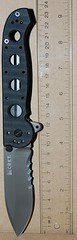
Beefier than an M16, the M21 is a formidable piece for anyone to carry.

Everyone most likely knows at least  one other person who has the ability to narrate extremely well and has ability to draw a listener completely into a story they retell. How many plant the hook and slowly reel in the listener, who is captivated by the idea, and then surprise them as the entire story was about something completely different from what was originally believed? Here at TPF, we were offered a chance to test out a bigger brother to the M16. That was when TPF was provided an M21 to review. Suffice to say that the excitement level at TPF was excellent and when the M21 finally came from Columbia River Knife and Tool we were extremely pleased. The author wonders if any of our readers was caught in the hook of the title?

The MG21-14G

Designed by Kit Carson and manufactured and distributed by CRKT, the M21 is a heavy-duty version of CRKT’s famous M16 line of knives.

Unfortunately this M21 is not the famed military variant of the classic M-14, nor a Norinco clone version of that illustrious firearm. In this installment of TPF, the M21 reviewed is an enhanced cousin to the M16, a folding knife designed by Mr. Kit Carson roughly a decade ago. Using his decades of military experience, personal knife making skills and outdoor knowledge, Mr. Carson designed the M16 to be a true functional knife. In 2003 the M16 was voted one of the top 10 tactical folder knife designs by Blade Magazine. The M16’s legacy has continued to this day as it is still in production and is still used as a benchmark versus other knives.  The M21-14G, as stated before, is an enhanced brother to the M16, measuring an impressive 135mm (5.3″) long while closed and massing a fair 167 grams (5.9 oz.). These larger blades of the M21 series have also earned the nickname of ‘Big Dog’ for it’s overall size and sporting a 3.6mm (0.14″) thick blade with a length of 98.4mm (3.87″).  The M21-14G version in this TPF installment has a self-described as a deep-bellied spear point profile, measures 235.0mm (9.25″)  when fully opened and features a trademarked series of Veff serrations.

MG21 - by Kit Carson

Bigger handle, tougher blade, more carry options equate to a full redesign of the iconic M16 into the M21

MG21 measured

Open length of over 230mm

For those individuals who are unfamiliar with Veff serrations, they originated on commercial knives back in 2006 and TPF has quoted from Mr. Veff’s website the following:
Veff serrations are unlike traditional serrations which are usually small scallops oriented at 90 degrees to the blade cutting edge.  Veff Serrations are wide and cut at about 50 degrees to the cutting edge.  The resulting cutting points bite instantly and dig deep upon contact while the large surgically sharp valleys slice smoothly and effortlessly.  Unlike traditional serrations that tend to snag and stick while cutting rope and similar material, Veff Serrations slice through cleanly and easily.  This produces dramatically improved cutting ability on rope, webbing, strapping, hoses, leather and vegetation.  Veff Serrations have been extensively tested and have proven to be the most efficient and effective serrations to date.
CKRT has in fact exclusive manufacturing rights to this design, other than Mr. Tom Veff customizing the serrations onto selected knives. The orientation change creates an effect similar to a series of miniature gut hook style cutting surfaces. The profile increases the cutting surface length of the serration edges, the small ridges between help create the sawing effect and draw the item being cut into the edge.

MG21-14G Veff

Showing off the Veff serrations and Kit Carson’s signature knurled thumb studs, the M21-14G is a hefty folder

The blade of the MG21 is manufactured from 8Cr14MoV stainless steel like many CRKT folding knives and is one of the higher quality knife steels available from China. The metallurgical properties place it somewhere between 440B and 440C stainless steel characteristics. With the blade hollow ground and treated with a Titanium Nitride coating, the M21-14G is a very sharp and imposing  looking tool. To open the knife, a pair of knurled thumb studs are attached to the blade’s spine for ambidextrous opening, as well as the “Carson Flipper” incorporated in the blade itself. The Carson Flipper was introduced nearly 15 years ago and is a kick incorporated into the actual blade which allows for partial opening of the blade through use of a finger on along the back of the closed knife. Now a very commonly feature on SAO knives, this version of the kick is used in conjunction with a slight wrist movement to obtain blade opening speeds similar to spring assisted knives. When the knife is in open position the ‘Casron Flipper’ tab also serves as a means of preventing the user’s hand from sliding into the cutting edges during usage.

MG21 the guts

This M21 is a very large and beefy blade which is locked into position via a liner lock, and CRKT also utilizes an AutoLAWKS system on the blade which prevents inadvertent closing of the folder. The AutoLAWKS is a spring actuated lever which interposes itself behind the liner lock once the knife is fully opened. This prevents the liner lock from slipping out and having the blade close at inopportune times. In order to close the blade , the AutoLAWKS. lever must be shifted, which allows the liner lock to be disengaged. This can be done one-handed with practice, but would require time and repetition to make such a smooth manoeuver. The 14G blade version incorporates grips manufactured from black G10 and have a textured surface finish to allow a firm grip regardless of weather conditions and the grip halves are retained by a set of Torx-head screws. While the knife itself comes with a retention clip setup for tip down carry and located on the right side of the knife, there are provisions for mounting the clip on either side and in tip-down carry positions. The clip is also secured by a trio of Torx-head screws.

MG21 features

Closed position focusing on the Carson Flipper with CRKT’s AutoLAWKS lever along the spine of the M21. Also showing the default position of the pocket clip

Designed by Mr. Kit Carson to be a rugged, heavy-duty knife based upon the successful M16 predecessor, the M21-14G has an MSRP of $89.99 USD. Other options for this size M21 include double ‘Carson Flipper’ tabs to create a cross guard, colouration changes, and the option for a plain ‘Razor-Sharp’ cutting edge. TPF Online thanks CRKT for its support in allowing us to continue to review its product lines. The M21-14G which is available at many locations across Canada including Wholesale Sports which has numerous storefronts and an online store as well. The final decision on the knife’s classification of Tactical, Practical or Fantastical is up to you, the reader.

The box.

The M21-14G initially being opened for reviewing by the author. What a fine piece of kit with minimal fluff packaging

Camping or hunting, SOG’s Woodline is an answer…

This author has had many opportunities to review knives of several manufacturers, and yes; even more are upcoming. However, once in a while, a slightly different knife comes about from the rest of those which have already been examined by the hands of TPF. Now as has been stated previously, and will be stated again, the authors of TPF are not knife experts, while the terminology and knowledge are still being accumulated, TPF should not be categorized as an expert. At this time, that is… Today we get to look at a sample of SOG’s product line, the Woodline series of knives. According to SOG’s website:

That feeling of leaving civilization behind as you move out of the valley and into the woodline is the inspiration for this series of fixed blades and folders.

SOG's Woodline

With an upswept tip, the cutting edge of the Woodline is long and flows into the overall design.

The Woodline series of knives consist of both a larger fixed blade and a smaller folding blade design. At one time a smaller fixed version was offered but it was discontinued for 2012. Now for the meat and potatoes of this review. The Woodline fixed blade is a non-serrated, trailing point design which measures 264mm (8.4″) overall and masses 235gr (8.3oz); resulting in a large knife for belt mounted EDC. In the author’s opinion this is a field knife, carried and utilized in specific situations such as hunting, camping and other outdoor pursuits which allow for extra bulk and mass to be carried.

The Woodline's Spine

With many thumb grooves on the spine and a large finger groove in the bolster, the knife has many good control features.

Sheath

Secured in 7oz leather

The extremely long curved cutting edge of the Woodline’s 122mm (4.8″) blade designed to a good knife for skinning, and with the 3.8mm (0.15″) thick spine the blade can withstand considerable abuse. Made with the standard SOG material, 8Cr13MoV Stainless steel, the knife itself should be able to keep an edge well and be readily sharpened. On the back of the spine are numerous thumb grooves to aid in fine blade control, which is required to prevent unwanted cuts and nicks with the upraised blade tip. The bolster, the metallic section between blade and handle, is made from cast stainless steel and creates the large finger groove in the handle’s grip profile. The tang of the knife is completely encased in very smooth hard wood which is retained by a series of stainless steel torx head screws. The final accoutrement is a lanyard loop consisted of a stainless steel tube imbedded in the end of the handle.

The sheath is composed primarily of 7oz leather with the reviewed piece having a nice uniform dark brown colouration. The leather sheath not only covers the entirety of the blade edge, but nearly the entire bolster and a small portion of the hardwood handle. Blade retention is accomplished though a single leather strap using a press snap button. This strap wraps around the generous finger groove formed in the bolster of the knife. A single belt loop, also made from 7oz leather and 20mm (0.8″) in width, is riveted place.  A basic SOG logo is branded into the face of the sheath.

Woodline ,the set

SOG’s Woodline fixed blade has nice curves and is complimented by the simple and functional sheath.

The Woodline fixed blade knife by SOG is an impressive looking product , appears to be very well made and creates an attractive package with the dark leather sheath. The only additional observation which can be made by TPF is that the knife itself is made outside of North America, which does keep manufacturing costs down, but may affect the purchasing decision of prospective buyers. The SOG WD-01 Woodline, large fixed blade knife as reviewed by TPF, has an MSRP of $60USD and is available with many Canadian retailers including various Canadian Tires stores across Canada.

The question, as always, posed to you, the reader, is whether this item is Tactical, Practical or Fantastical?

Getting into Action Shooting – Part 3

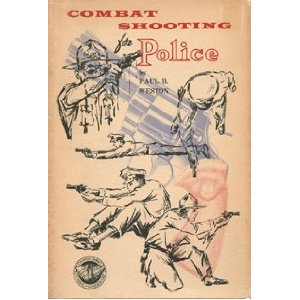
Actual book from 1960Combat pistol shooting has been around since the early 1900’s as military forces and law enforcement began to use handguns as a means of defense. Even back nearly 50 years ago, combat shooting was practiced by law enforcement as a means of training law enforcement officers (LEOs) to be able to effectively and accurately use their service pistols in a variety of shooting positions. A six shot revolver chambered in .38 Special was the standard staple of these LEOs so accuracy was an extremely important skill to have with their limited ammunition capacities. Remember that while a 1911 was designed over a century ago, most semi automatics were very expensive compared to the revolvers even just a few decades prior to today. This version of Combat Shooting has survived today as Police Pistol Combat (PPC) and is seen as the for-runner to current dynamic action shooting disciplines. It wasn’t until the late 1960’s and early 1970’s that the true combat shooting was starting to take shape in today’s version which incorporates drilling the concepts of threat identification and tactical awareness as well as accuracy while under stress. For readers who are in the younger generations, TPF recommends you go and look for the movie Magnum Force (1973), starring Clint Eastwood, and you will see a small snippet of the fore-runners of today’s action shooting with the “Combat Shooting Championships” in the . Please remember that movie is nearly 40 years in age and at the time action shooting sports had not been truly established. While PPC was, and is still today, practiced both a discipline and sport, it was the foundation for what developed into the modern action shooting sport, such as International Practical Shooting Confederation which was officially formed in 1976.

As the concept of getting into action shooting sports has already been addressed in Part 1 and Part 2 of this series, this installment is to those individuals have already tried their hand at the fun filled world of action shooting. As TPF has inferred in the aforementioned posts, the majority of the experienced people who participate in action shooting are extremely friendly and open. Now some of these people now train others and use their vast amounts of experience and knowledge and years of refined skills to help jump start newcomers into shooting, and to enhance skills of those familiar to the sport. TPF, on behalf of the CSSA was able to interact with many of the shooters in the previous installments and get a quick tip from them. Please recall that many of these people make a living from training people how to become a better shooter and as such will only give small snippets of advice outside of a training session. TPF is honoured by the following individuals for their time and efforts at promoting the shooting sports and for their willingness to assist new shooters in some tips which they have found helpful in being a superior competitive shooter.

A huge supporter of IPSC and the owner of Freedom Ventures in Canada, Mr. Sean Hansen graciously gives TPF readers a quick tip on improving your shooting ability.

STI International sponsored competitive shooter, Mr. Blake Miguez is very open and a great individual whom was very forthcoming when asked to share his insight of how to improve one’s shooting prowess in action shooting. Mr. Miguez’s Facebook site here.

Michael Voigt is one of the true veterans of the shooting sports with many years of experience and skill under his belt. You will not how much he enjoys discussing the sport he has loved for many, many, years of dedication. Mr. Voigt’s website here.

Rob Leatham is to Action Shooting what Wayne Gretzky is to Hockey. Considered by many to be the overall grand master of knowledge and techniques from years upon years of being one of the best in the world in action shooting. Mr. Leatham’s website can be found here.

Angus Hobdell has been shooting CZ handguns for so long that the two are nearly interchangeable when talking about one or the other. A great  great love for the shooting sports and a very friendly nature to all, means that Angus has no issues in letting TPF readers in on one of the small secrets for a successful shoot. Visit Angus Hobdell.s wesite here.

With a good sense of humour and a great demeanor, Ms. Tierani Hendrix is a credit to the shooting sports with her outgoing personality. While at the 2012 SHOT Show, she spared a small amount of time to give new action shooters a tip for improving. Her website can be found here.

Ms. Randi Rogers is pure gold in her enthusiasm for shooting sports and has an amazing level of skill and energy which she is always more than happy to share with new shooters. TPF was able to “co-erce” Ms. Rogers into offering a helpful hint just by asking her. Find Randi Rogers’ website here.

Para-USA Shooter, Travis Tomasie was yet another professional shooter who is happy to help out prospective shooters aquire higher skill sets and compete in action shooting sports. Travis’ website can be found  here.

TPF would like to thank all the professional shooters who were willing to spend a moment of their time to assist TPF in these videos. Unfortunately these videos were all done in a limited time frame and due to these time constraints only a few were approached. If readers have any specific shooters, or questions to have asked of these shooters, please ensure that you write us with your suggestions here!

Regardless if it is Tactical, Practical, or Fantastical; the popularity of action shooting sports is on the rise. Thanks for reading!

Back to basics – Lessons and results by Gerber

Packaged

The Card packaging for the Gerber Basic knife

With advances in technology and more advanced manufacturing techniques, ergonomic sculpting, exotic shapes, and highly technical mechanisms have seemed to become a mainstay of many of today’s manufacturers and Gerber is no exception to this as evidenced by the creation of the Flik multi-tool previously reviewed here at TPF-Online. Gerber has been around for quite a number of years and has made countless designs of knives, multi-tools, and other products which are used by a great many people around the world. However they realized that as technology advances, there is still a very basic principle which needed to be heeded.

What is the basic definition of a knife? A tool used for cutting. That was the entire concept behind the knife being reviewed today. The Basic, a fixed blade knife by Gerber was designed and began production several years ago. As stated, it was a throwback in design with the primary factors being size, generic functionality and durability.

The Basic is just that, a very basic everyday utility knife. Featuring a 76.2mm (3.0″) drop point blade design, the blade is very typical for many knives and follows a sabre ground profile for strength. The cutting edge is partially serrated for true multi-purpose design utility. With the spine/full tang measuring 3.8mm (0.150″) in thickness, the robustness of the design is very apparent. While the overall knife length of 168mm (6.6″) makes the handle small, the huge large finger groove/choil behind the blade edge allows for a very secure grip. Due to this large choil it almost appears that the small grip panels were added as an afterthought to the full tang of the Basic. TPF has noticed however that the blade length has been listed at various sites, including Gerber’s, as nearly 86.5mm (3.40″) in length which would be measuring from blade tip to the leading edge of the grip panels. The grip panels themselves are not spectacular, primarily being made of nylon, and each side is secured into the full tang by three small Torx head screws. However a large portion of these nylon panels mount Gerber’s TacHide™ grip material which is very soft and provides a very secure grip on the knife. The full length tang incorporates a trio of scalloped indents on the spine as thumb ridges, in addition to the large lanyard loop incorporated in the full tang and accentuated by the grip panels.

Presenting the Basic

The knife is truly basic in design, the sheath is not…

Grip and Loop

Showing off the TacHide inset panels and the large lanyard loop

TPF was unable to determine the mechanical properties of the steel used to manufacture the Basic, but a source says that the blade is most likely constructed with 420HC stainless steel, which is nearly a default for Gerber products unless otherwise indicated. The entire blade and tang are nitride coated for additional corrosion resistance and results in a generally matte dark grey finish. Overall knife mass is roughly 105 gr (3.7oz) which is considerable when combined with the very small size of the knife itself. It seems to be a success when measured against the basic design principles used for it’s creation. However, TPF will note that the handle profile, while designed for extreme comfort and great control, is somewhat diminutive for those individuals whom have larger hands as the knife becomes a three finger profile.

Sheath

Slightly pushing on the upper edge of the sheath reduces the tension friction retaining the Basic

The sheath of the Basic is the complete opposite of the knife in terms of simple design criteria. Created from two molded halves mated together, the completely polymer sheath is a marvel of modern design. A plastic tension catch is part of the molded sheath and securely retains the Basic knife with a force that would potentially overcome the reversible metallic belt clip. The clip is positioned for right handed carry and is made of a stainless spring steel. Retained by two small screws similar to that of the belt clip, a small metallic plaque is on the opposite side of the sheath proudly displaying the Gerber name. TPF did not try to reverse the clip as the durability of the sheath is most likely the weakest point of this entire package. Combined the Basic knife and sheath measure only slightly longer than the knife itself at 173mm (6.8″) and the small package, while fairly heavy is indeed a worthy addition to nearly person’s knife inventory.

Controlability

The large finger groove, TacHide grip and thumb scallops made the Basic very easy to handle.

The Basic knife as offered by Gerber Gear, is a fixed, partially serrated blade which has an MSRP of 43.00USD, and is available at many outdoor supply stores as well as online retailers such as www.canadiansafetysource.ca. As usual however, it is up to you the reader to decide if the Gerber Basic is Practical, Tactical, or Fantastical.

The First Annual Dead Registry Celebration – April 28th, Gatineau, Quebec

Since its inception back in 1999, the Canadian Shooting Sports Association has held a fundraising dinner which has since become known as a “Stick to your Guns” dinner. Originally an annual event, this dinner has been expanded to be held several times a year in various locations across Canada. These dinners have had such notable speakers like Sandra Froman (former NRA President, 2005-2007), and long time supporter and a true friend to Canadian firearms owners, MP Garry Breitkreuz. In recent years a specific annual version has become linked with the CSSA’s Annual General Meeting, and this one was held on April 28th in Gatineau, Quebec.

The last time the author was in the region, the city of Hull had not been amalgamated into Gatineau and the author had barely begun to become involved with firearms. It seems so long ago, but the city and region hold many worthwhile attractions for visitors. So if you get a chance, please ensure that you visit one of the many museums in the area. Now, as this was to be the first of the CSSA AGM’s held in the province of Quebec, there was some anxious times for organizers leading up to the event as turnout was an unknown factor, but all the their worries were for naught. Nearly ninety (90) individuals braved the somewhat chilly weather to attend the CSSA AGM, of which roughly half were from the province of Quebec. With many questions asked by individuals in attendance and a great wealth of information about the efforts of the CSSA, the AGM was alive and resulted in a large volume of information disseminated to those in attendance.  As always the CSSA is humbled by the sheer volume of support from its membership, and hopes to be able to do even more in the coming months and years both domestically and abroad.

The Speaker of the House

Never one to shrink from what needs to be said, Dr. Ackerman becomes Speaker of the House during the CSSA tour of parliament

With the AGM wrapping up just after noon on the Saturday, the CSSA had decided to arrange a tour of parliament for the late afternoon prior to the fundraising dinner and this was available for attendees of the AGM. TPF was unable to attend the tour, but had heard that the tour was phenomenal with people being right on the House of Commons floor and sitting in both the seats of the Honorable Andrew Scheer, Speaker of the House as well as the Right Honourable Stephen Harper, Prime Minister of Canada. The entire structure of the parliament building  is a monument to history and grand construction of generations gone by. With exquisite stonework and inlaid patterning, it is amazing how well made the building is when one considers that the wiring and plumbing is nearly completely hidden from casual sight as you walk through out the building.

Lovig and Bernardo

A pair of great people, Brian Lovig (l) and Tony Bernardo grin in anticipation of a great evening!

At 6:00pm the “Stick to your Guns” dinner officially opened and began the festive evening, with it being the first CSSA fundraising dinner since the historic April 5th, 2012. This was officially coined as the 1st Annual Dead Registry Celebration, as it occurred mere weeks after the historic passing of Bill C-19. Even with some last-minute scrambling for setting up the prize tables, the evening proceeded with very little snags and errors. With Tony Bernardo being the Master of Ceremonies and Mr. Brian Lovig of the Daily Split being a co-host, the evening was anything but dull. Not one, but TWO speakers were in attendance that evening with Mr. Garry Breitkreuz being the initial speaker and telling about the trials and efforts that have been endured and overcome by the CSSA and those who believe in firearms freedom. The keynote speaker was mister Phil Morlock, one of North America’s leading experts in promoting heritage outdoors activities that include hunting, sport shooting, fishing and trapping. The praise which came from the mouths of these two individuals was humbling to the CSSA but also invigorated those in attendance to continue to stand up and fight for the Canadian firearms community.

Doorprizes

Ranging from pens to gun-mugs, hats to gun socks; the door prizes alone were numerous and varied.

With good food and nearly one hundred attendees, the dinner started off on a great note and the sheer number of prizes were astounding. There were many spectacular prizes available and the top ones were two of the four rifles available that evening. To quote the host’s repeated mantra, “Did we mention that these rifles were UNREGISTERED?” Many thanks to those who won the Chaparral Winchester Model 1866, the Carl Gustav 63 target rifle, and the plethora of prizes that were available. Many thanks must also go to Mr. Brian Lovig for his professional assistance in auctioning off some prizes, such as the Model 1866, to the attendees. Some of the raffle draws were very well received and quite innovative such as the Joker Draw which was a beautiful stainless Ruger 10-22 rifle with laminated wood stock. The catch? There were only 12 tickets available so it was a 1 in 12 chance to win. Just amazing and so well received by the audience.

Topgun

The grand prize of the evening was this beautiful Chapparal Winchester 1866 chambered in .357 Mag. Many thanks to John @ Marstar for his support of the CSSA and these events!

A special thanks to the following for their support and help in what was a truly extraordinary evening. These companies and individuals are part of Team CSSA and contribute to the success of the organization to keep the fight in the face of the gun grabbers and ensuring what is accomplished is lasting and stays beneficial for Canadians.

  • John St. Amour, Marstar Canada
  • John Mock, Stoeger Canada
  • Bob Nichols, R. Nichols
  • Daniel Legault, Browning Canada
  • Anthony Toryni, Trade Ex Canada
  • Ken McRory, Vortex Optics Canada
  • Brandon Bulter, Battenfeld Technologies (Caldwell/Tipton)
  • Ben Krete, The Gun Centre
  • Mandy Esteves, Shooting Chrony Inc
  • Dave Landsborough, Triggers and Bows
  • Lee Morgan, Gunzilla Canada
  • Tony Bernardo, Canadian Institute for Legislative Action
  • Brian Lovig, The Daily Split
  • Garry Breitkreuz, CPC Member of Parliament for Yorkton-Melville
  • Hornady, Kershaw, Forster, Lyman, and several more companies
  • Luc Thivierge, Chris Youngson, Norm Lapierre, and so many more individuals

After all the food had been eaten and all the prizes had been doled out to winning attendees, the evening was far from finished. The CSSA went the extra step and provided a live band for the remainder of the night. “Reloaded” was a garage band made up of some veteran and professional talent from the ranks of the CSSA itself. Armed with his Gretsch guitar, Tony Bernardo lead the group with professionalism, Rob Alexander invoked his keyboard with practiced skill, Brant Scott wailed with purpose on drums and Dave Weston put up the backbone bass with fingers flying. With the occasionally addition vocals provided by Tony’s daughter, Kira; the night was filled with electricity and was possibly the finishing stroke in completing a picture perfect day of energy and enthusiasm.

Many thanks to all who helped make the entire day a memorable one and hopefully TPF will see you again next year at yet another CSSA AGM, if not sooner at more of these fund-raising dinners.

April 5th, 2012 – Fighting for over a decade and a half, finally a win.

Scrapped the Registry

April 5th, 2012. Registration of non-restricted firearms has ended.

It was 16.5 years ago, specifically December 5th, 1995, that Bill C-68 had received royal assent by the Liberal Government of the time and under the watch of the Prime Minister Jean Chrétien. C-68 was the beginning of the most recent level of totalitarian “gun control” in Canada. Firearms classifications had been enacted back in the late 1960’s which first started the whole notion of restricted and prohibited classes of firearms as well as the government’s ability to classify firearms with an Order-In-Council. Here TPF gives a basic rundown of “Gun Control” in Canadian history.

1934: The first version of modern registration of all Handguns occurred in Canada. Registration was done by the local constabulary.

1939-1944: During the wartime shotguns and rifles were required to be registered as well as handguns. This was used to confiscate arms from Canadians during the wartime period such as those who were placed into Japanese Internment Camps and suspected Axis sympathizers. After the war the act of registering shotguns and rifles was discontinued, yet handguns were still to be registered.

1951: Registration of handguns was centralized and under the auspices of the RCMP. Automatic firearms are required to be registered alongside of handguns.

1977, August 5th: Bill C-51 receives royal assent and introduces the Firearms Acquisition Certificate (FAC) and many firearms are classed as prohibited due to fully automatic capabilities. People could no long carry restricted firearms for defence of property.

1991, December 5th: Bill C-17 receives Royal Assent which enhances scrutiny of FAC system with more rigorous identification and background checks, but at this time the FAC is still only required to acquire a firearm. A firearms safety competency requirement was attached to the FAC process.

1995, December 5th: Bill C-68 receives Royal Assent. A new licensing system is introduced to replace the FAC system as well as a complete rewrite to the criminal code and the introduction of the Firearms Act. Firearms themselves are now illegal to possess unless you have a valid license. ALL firearms are now required to be registered.

C-68 was a huge piece of legislation which was fraught with many many gaping errors and obvious poor judgement, at least apparent to anyone who used firearms for legal purposes. There were numerous sections of the bill which had the firearms community, the top firearms experts, and many in government opposed to its passing. The sheer scope, convoluted wording and sledgehammer like repercussions were well voiced to those who wrote the bill. The bill was so massive and unwieldy that it was to come into force nearly 3 years later, December 1st, 1998. In September of 1998, where over 30,000 individuals had joined together on parliament hill in the “Fed-Up II” rally against Bill C-68, then Justice Minister Anne McLellan ignored the gathered firearms owners and instead addressed solely the media. She stated “The debate is settled. The debate is over.” For years following there would be delays and small changes and updates ad nauseam to Bill C-68. It was not until January 1st, 2003 that the entirety of C-68 officially came into force. It took over seven (7) years to implement the bill and have enough people “enroll” into the new control regime and have it officially launch.

Now in general, the government of the time was either lying to Canadians or at best feeding them incorrect information as by the time the Bill C-68 fully came into force, the proponents claimed that the 2 million Licenses and 8 or so million firearms represented 97% of the firearms owners and firearms themselves in Canada. These numbers have since been proven to be not only incorrect but an order of magnitude out of scale.

In 1945 the total number of Registered Firearms was nearly 2 million in number. Fast forward to 2001 and when you include known import and export records (not illegally smuggled guns) and include a small percentage for destroyed/damaged/broken/disposed firearms you are at nearly 16.5 million guns. By 2003, only 100,000 handgun owners had acquired a license, down slightly from the 400,000 who had FAC’s. The sheer volume of people who did not comply with C-68 should have been a wake up call to the government of the time. Sadly it wasn’t.

Then in 2006, change happened. The Liberal government was ousted from it’s position as official government of Canada. A political entity which did not irrationally detest firearms ownership assumed the mantle of government. Prime Minister Stephen Harper and the Conservative Party of Canada took office and tried numerous times though a variety of introduced bills to remove at least the registration of non-restricted firearms. Some bills additionally covered far more onerous aspects of the firearms act, and on occasion the bill introduced was worse than what was before. However, on October 25th, 2011; Bill C-19 was introduced into the House of Commons. It’s target? To eliminate the entire process of registering Non-Restricted firearms and to destroy all accumulated data records of such firearms.
On April 5, 2012, Bill C-19, Ending the Long-Gun Registry Act, came into effect with the following effects (from officially released documents)

  • Removal of the requirement to register non-restricted firearms
  • Destruction of the existing non-restricted firearms registration records
  • Allowing the transferor of a non-restricted firearm to obtain confirmation of a transferee’s firearms acquisition licence prior to the transfer being finalized
  • Until further notice, due to a Court Order issued by the Quebec Superior Court, residents of Quebec are still required to register non-restricted firearms with the RCMP Canadian Firearms Program.
  • It is important to note that the new law does not change the requirement for all individuals to hold a licence in order to possess a firearm. The licensing, safety training and safe storage requirements for anyone who uses or owns a firearm continue to be in force.
  • The legislation also does not impact registration requirements for restricted or prohibited firearms.

Now the province of Quebec has, at the time of this writing asked for and received a temporary injunction regarding the data and registration of firearms in Quebec, but this injunction is to allow for an evidentiary or preliminary hearing regarding the case. This hearing is to determine if the case can be brought before the courts (jurisdiction) and to determine if there is any chance of such a case succeeding from presented preliminary evidence.

All this means so far is that Quebec is presenting their “case” to a judge who is going to rule if the case can firstly, be brought to trial by the Superior Court of Quebec (Provincial jurisdiction) and secondly, that there is even enough evidence for any reasonable outcome prior to going to trial. For example. The injunction has forced Quebec to continue to register non-restricted firearms, and continue to update and maintain the registry data. It is up to this judge to determine if he even has the authority to allow this case to be brought forwards. Should that occur, the judge may rule that only the data pertaining to residents of Quebec can be asked for through the court as Registration is a Federal Mandate currently controlled by Federal Policy. Or any combination of the above…

For the rest of Canada however, this means that the registration of non-restricted firearms is finally rescinded. Many people are even calling April 5th,  Mini-14 Day, as a form of insult and snub towards the anti-gun fanatics who have deemed the Ruger Mini-14 as the foremost symbol of why “Gun Control” should exist in Canada.

 The snub is intentional as the zealous gun-grabbers refuse to admit that it the tool used to commit violent  criminal acts is just that. A tool, be it a gun, blade, vehicle, fist, club, or any other item used to inflict malicious harm is not the cause of the harm. It is the person who is committing the violent act. Period. But alas, such truth and unassailable logic falls upon the deaf ears of the fanatical anti-gun activist.

With the temporary injunction set to end at 5 PM (EST) today, Friday the 13th, many individuals are awaiting to see the final outcome of this hearing. Quebec will already get its day in court sometime in June, regarding  the transferring data of Quebecers contained in the non-restricted registry; but the current arguments before the court is to determine if the injunction will remain in effect until that case is settled. The current government has vowed to not allow the existing data to be used to creat a provincial registry. Either way it seems that it will be a long drawn out process to see the outcome of this case, and  of Canada’s firearms community hopes for the best possible outcome for their Quebec brethren. That best event? The final nail in the coffin that is registration of non-restricted firearms.

TPF Online thanks all those individuals whom have championed and fought through these last decades to make this event a reality. Lets help them out and continue to fight for sensible laws which target and punish the criminal element!

Getting into Action Shooting – Part 2

Getting into Action Shooting – Part 2! – On behalf of TPF-Online and the CSSA! Part 1 can be found here!

Continuing the theme of how to get people into action shooting, or at least experience shooting sports in general, TPF-Online once again brings various video snippets from the ranks of the extremely knowledgeable and experienced names in action shooting. Once again however, TPF cautions that many of these interviews come from a American point of view, which is somewhat different due to the prevalence of shooting sports in the United States when compared to Canada. Thanks to the efforts of organizations like the Canadian Shooting Sports Association, podcasts like that of Canadian Reload Radio, and people who want to help grow the sport and educate the unknowing to the fun and sport of shooting.

First up is Tierani Hendrix, a wonderful person who has been shooting since 2008, only a scant 4 years; and whose skills have earned her a spot on Team Smith & Wesson along side of legendary competitive shooters like Jerry Miculek. Ms. Hendrix is consistently one of the top women shooters in the realm of IDPA, and TPF was able to snag a few moments with Ms. Hendrix while she was attending Safariland, one of her sponsors. Even with a quick sponsor plug, she tells you what who can do regarding entering into the shooting sports.

One of the legends of experience and techniques, Michael Voigt, took a small bit of time out of a hectic SHOT Show schedule to spend a bit of time with TPF and discuss with Professionally shooting since 1979, Michael Voigt has over 20 years of experience and developed techniques under his belt. Since 2001, Michael Voigt has competed with Jerry Miculek for the tops spots as Nation champion for USPSA’s 3-Gun Open division, proving that skill and experience is still a driving force in these action shooting events. Many thanks to a great gentleman and sportsmen for sharing his thoughts to the readers of TPF Online.

From the age of 11 Randi Rogers has been shooting, and shooting, and shooting. Even though her first true exposure was to Cowboy Action Shooting due to her upbringing, she has embraced almost every style and type of action shooting. A true champion who has been national champion in SASS, IDPA, IPSC, USPSA, and several other disciplines; TPF Online was pleased to be able to have Ms. Rogers give a small bit of insight into getting into action shooting. At the time of the SHOT Show when this video was taken, Randi Rogers was an employee and  member of Team Glock, but has since transferred her business acumen and shooting talents to Comp-Tac.

A relative newcomer to Team Para-USA, Travis Tomasie is no stranger to guns having served in the military and being a member of the US Army Marksman Unit Shooting Team for eight years prior to joining Para-USA in 2011. Never heard of him? TPF will bet you have seen of him is you have ever looked up action shooting on Youtube. Search for the fastest reload and you’ll see Mr. Tomasie in action. Mr. Tomasie honoured TPF-Online by taking some time out of his schedule at the 2012 SHOT Show and giving his take on how to get into action shooting.

She has spent over 80% of her life shooting, and no, she is not very old at all. Tori Nonaka, shooting since she was three years old, and currently a member of Team Glock shares her ideas of how to get into action shooting.  Her youth and drive are evident as Ms. Nonaka graces TPF with a few moments of her time at the 2012 SHOT Show. Many thanks to Ms. Nonaka for giving your opinion and showing TPF readers how much you love shooting!

Another veteran to shooting, Doug Koenig began his shooting career back in 1987, and is classed as one of the best all round shooters in the world. In 1999, at the age of 20, Doug Koenig was the first ever person to shoot a perfect score at the Bianchi Cup. He is a great competitor and has a wealth of experience and skills which people can learn from. Here Doug Koenig shares a moment with TPF-Online to describe how to find and get involved in action shooting sports.

Talking to these individuals is a great pleasure for reasons mentioned previously. Such individuals are thankfully not rare in the action shooting sports, and by that TPF-Online is heartened by the open and welcoming attitudes which many, if not all, of these top competitors have.

TPF hopes you the reader, and viewer in this case, hold your judgement until you see some more future shooting personalities in later installments, but as always; action shooting. Is it Tactical, Practical, or Fantastical?

Guns and tanks in the GTA – 2012 Toronto Sportsmen’s Show

How many readers can remember “March Break” as a time when one was glad to be out of the classroom for a week and enjoy what was supposedly the end of winter. It has been a long time for the author since school work and study dominated his daily routine, but “March Break still holds some semblance of freedom and desire, and that is the annual Toronto Sportsmen’s Show. As with each and every year, the city of Toronto becomes a focal point for tens of thousands of individuals who attend a multi-day event which is billed as “Canada’s Biggest Fishing &  Outdoor Show”. The Toronto Sportsmen’s Show, hereafter referred to as TSS, started six and a half decades ago and has growth to encompass hunting, fishing, outdoor adventuring and to the surprise of many Toronto natives… GUNS!

With the show located on numerous levels and across two buildings at the Metro Toronto Convention Centre (MTCC) from Wednesday the 14th of March until Sunday the 18th, the show was host to several hundred exhibitors and multitudes of individuals. Please allow a bit of reflection however on the history of the TSS. For sixty two (62) years, the Toronto Sportsmen’s show had existed in one form or another as an annual event located at the Canadian National Exhibition grounds (CNE), but due to the unfathomable machinations of, the previous Toronto Mayor, David Miller; forced the show to relocate to the MTCC in 2010. Why Miller’s anti-gun zealotry deemed it necessary to destroy so many decades of history and pride is beyond comprehension. Now on its third year away from the CNE, the TSS is once again running what is now their 65th anniversary. It was estimated that the City of Toronto lost nearly $14 million of revenue when the show shifted locations, the reason being that all revenue from the MTCC flows to the province of Ontario, not the city. Fast forward to 2012 and Toronto Mayor Rob Ford is opening the show which he has attended since he was a child and the hunting hall is growing.

TSS CRR CSSA

Canadian Reload Radio host, Andrew Craig, helps promote the CSSA while showing off a custom silhouette rifle

As always, the Canadian Shooting Sports Association was present at the TSS and with the help of many volunteers was able to once again have a successful show in terms of membership growth and engaging in discussion with probably thousands of individuals throughout the duration of the show. Many thanks to CSSA Regional Director Gus M. who volunteered far more than what was asked of him and to Mr. Andrew Craig of Canadian Reload Radio fame who brought in his custom centre-fire silhouette rifle and a small video which was a great draw and topic of discussion. The CSSA thanks all who helped them with another successful show and as always the main topic of discussion was the demise of the Long Gun Registry (which TPF is proud to state just passed clause by clause reading  in the senate as the author edits this entry).

Over the five (5) days of the TSS, several tens of thousands of attendees were able to experience a full gambit of outdoor pursuits as the show caters to the public and the newest wares and a “One stop shop” for nearly every outdoor need. In fact many attendees left the show in possession of products which were impulsive purchases in the first place. TPF however will concentrate this TSS review in the Hunting Hall aspect of the event. As always the primary focus of the Hunting Hall aspect was for Outdoor adventures such as hunting, hiking, boating, with additional luxury products as well as some interactive displays and pavilions being present.

TSS1

Outdoor gear was just one small portion of the hunting hall areas of the Toronto Sportsmen's Show

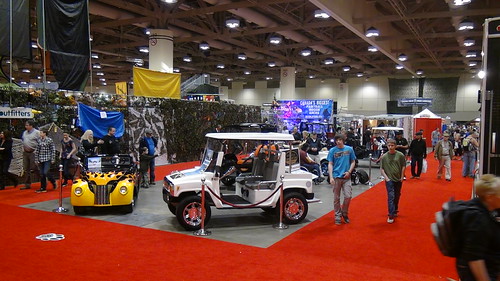
TSS2

Custom ATVs and Golf Carts were some of the higher end, luxury products on display as well.

TSS_TacImp

Displaying restricted firearms in the cabinets, Tactical Imports is the fire to have such firearms for sale at the TSS is several years...

This year was a slight departure from the norm, not only were there far more firearms on display for sale by retailers, this year represented the first time in many years which restricted firearms were for sale, let alone on display. Many thanks to Tactical Imports, whom took the first step, with the assistance of Mr. Tony Bernardo and the CSSA, were allowed to bring in some of there more “exotic” firearm products for the public to not only view  order from them. Initially the TSS was refusing to allow Tactical Imports into the venue as it did not fit in with the traditional “Hunting” definition. When pointed out that many of the exhibitors, such as that depicted in the previous luxury product image, had little if anything to do with “Hunting” and that a firearm is a firearm, the TSS removed their objections and Tactical Import set up their display. Showing both non-restricted and restricted firearms in their booth, Tactical Imports has started what may be a growing trend by other exhibitors/retailers at the show. At least that is the hope of TPF-Online and many attendees whom we talked to.

TSA-Airgun

The Toronto Sportsmen's Association has run the air-gun range for many years at the TSS. Encouraging our next generations into the joy and fun which can be had in our shooting sports.

As always some things never seem to change and that is a good thing in the case of the Toronto Sportsmen’s Association (TSA). The TSA crew has been coming to the TSS for many many years, and has always been the ones who have run the air-gun and archery ranges at the show. They are a truly exceptional group of individuals who continuously are to be thanked for exposing the future generations to the shear enjoyment that is available in shooting sport disciplines. Many thanks to Mr. Edwards and his volunteer crew for all his time and efforts over the past several years for continuing to provide exceptional public awareness and hands-on experiences like these for our youth.

The Canadian Military has been present as well in the last few years with an ever increasing display of equipment and public outreach. The author ensured that every one of our men and women in uniform whom was met at the show was thanked for their service and their efforts. TPF-Online will side step here briefly and state for the record that Support The Troops ribbons, pins, and decals are not being pro-war, but pro-survival. One does not have to believe in the circumstances which led to Canadian military involvement, but we should all wish our fellow brothers and sisters in uniform to come home safely and with as due speed. A full gambit of military hardware was present for display for TSS attendees to look at, ask questions about, and receive answers.

RCA-LAV

Just one of several vehicles brought in by the Canadian Army, which were opened up for the public to view and experience

The Toronto Sportsmen’s Show is an annual event and it looks as though it is starting to grow out of the “traditional” mold of what constitutes our hunting aspects of outdoor recreation. That being said, the TSS is a huge endeavour which caters to the outdoors-man in most people in the Toronto region. So if you do not mind paying for parking and what some claim are excessive admission fees, you too can experience “Canada’s Biggest Fishing &  Outdoor Show” every year. As TPF-Online looks forwards to next year’s show once again, we put forward the standard question: Is the Toronto Sportsmen’s Show; Tactical, Practical or Fantastical?

Getting into Action Shooting – Part 1

Video games such as Call Of Duty, Battlefield, and other first person shooters have greatly increased the appeal of firearms to the younger generations. For this TPF cannot apologize, as despite knowing that such video games turn violence into a hyped up and marketable commodity, it has done more to get the next generation of shooters into the sport than almost any other combination of approaches. That in itself shows how much farther all shooters need to reach to not only accept the newest members of our sport and hobby, but how much they need to get off their own derrieres and teach the unknowing masses what they are missing.

Unfortunately it seems that fewer people nowadays are hunting and the reason for that is because for the last couple decades, firearms have become publicly of crime and unlawful activities. Nothing can be further from the truth as 99.9% of firearms owners are caring, safety conscious individuals who, outside of hunting and wilderness survival, would find it very difficult to ever commit any form of violent act against another living creature. TPF authors personally know individuals who are firearms owners and refuse to even consider playing paintball or air-soft games for the simple reason that to play those games one would have to point a “gun” at another person. That being said the author has no issues with paintball, nor air-soft, as both are akin to the firearms community. They build teamwork, camaraderie, and just as actual firearms usage, safety is the number one responsibility of all those involved.

While hunting with firearms appears on the surface to be in decline, the reality is that more and more shooters are gravitating towards handguns, “black rifles” and action shooting sports. Readers should recall that in June 2011, TPF did indeed mention some of the various action shooting disciplines available to people. This time around TPF-Online is proud to have been able to enlist several individuals who compete professionally and have them give a tip or two about what to do if you are interested in this category of extreme sports. Be advised that many of these shooters are based in the United States and have a much more prominent network for action shooting information and contacts.

Getting into Action Shooting – Part 1! – On behalf of TPF-Online and the CSSA!

First up is Canadian shooter Sean Hansen. President of Freedom Ventures Limited, and a multiple IPSC Provincial Champion in Nova Scotia, is a strong supporter of action shooting and enjoys many years of good memories and experiences regarding his efforts in action shooting and has many more years to create more.

Next up is Blake Miguez, whom at just over 20 years old holds the title of 2011 ISPC World Champion and is proof that shooting for fun can lead into more opportunities.

The lovely and talented Julie Goloski Golob shares a bit of insight on the simple and easiest method of getting into action shooting.

Talking to these individuals is a great pleasure for reasons mentioned previously. Such individuals are thankfully not rare in the action shooting sports, and by that TPF-Online is heartened by the open and welcoming attitudes which many, if not all, of these top competitors have.

TPF hopes you the reader, and viewer in this case, hold your judgement until you see some more future shooting personalities in later installments, but as always; action shooting. Is it Tactical, Practical, or Fantastical?

Just a bit more to whet your appetite as well…

Jerry Miculek – The fastest trigger in the world and arguably the best revolver competitor that ever existed.

Todd Jarrett – A world level competitor with millions upon millions of rounds of of experience and a great ambassador to the shooting sports as well.