Reviews & articles for shooting sport enthusiasts.

Latest

Warfare against your hated enemies will never be the same…

You are trapped in your home and you are not alone. You can hear the intruder moving around as though they own the place. This time however you will be defending your self and taking the life from the defiler of your castle. You load up with the salt because you have heard it hurts more. You rack the slide and roughly aim down the sights. Holding your breath, you await the perfect moment to squeeze the trigger. Seconds later you are standing over the carcass of the intruder, grinning from ear to ear, knowing that there is one less piece of vermin to harass other innocents. Hearing more from others in the other room, you rack the slide again and become the hunter in your home, With the yellow and black gun in hand, you go forth to give the scum of the universe a lesson in Castle Law. Now before all of you readers start to A) Scream YES to self-defence, or B) Chastise the author for such fear mongering; please note that there are perhaps millions of these god-forsaken pests that deserve to be eradicated and that could just be those in your own backyard.

You read that correctly, TPF-Online has gotten to review one of the most sought after guns in the last couple years. You may have seen the videos online and you might have dreamed about owning one to complete your arsenal of weapons for removing unwanted guests from your home; but this gun is all about filling the target full of holes. Holes made by salt. Huh?!? That is correct, TPF-Online is pleased to be able to bring our readers a review on the Bug-A-Salt.

bugasalt-01

When you absolutely want to send those wretched pests into an early grave… Bug-A-Salt may be just the right tool for the job

Bug-A-Salt_Logo

The logo of Bug-A-Salt’s parent company is displayed on the lid of the salt “Ammunition” storage

Conceived in 2010 by the mind of artist (and surfer) Lorenzo Maggiore, the Bug-A-Salt took several years of conceptual work and testing until it was locked into it’s current design form. It was in late 2012 that Bug-A-Salt became reality, starting with a pre-sale effort on Indiegogo, a crowd-funding website, Mr. Maggiore created a conceptual video and created a goal of a $15,000 to be able to ship the first container of Bug-A-Salt guns from China to California. The response was staggering. Sixty six (66) days after launch, with a viral video, his fund-raising efforts caught the wallets of over ten thousand people across seventy countries, and raised in excess of a half million dollars when the fundraiser closed on September 11th, 2012.

Now it is the author’s belief that nearly everyone has at some point become seriously annoyed with house flies or other insects and bugs in their home. The Bug-A-Salt is a modern version of the fly-swatter. It does cost more and is far heavier, but it very rarely misses the target if used properly, unlike the swinging hands/papers/books/etc… The fact that it is in effect a miniaturized, air powered shotgun, is just an added bonus. Moulded in black and yellow plastic with numerous fly images embossed in the surface, the Bug-A-Salt measures approximately 550mm (21.6″) in length and masses 635.0 grams (22.40 oz) unloaded.

Loading the Bug-A-Salt is very simple. Open the flip-up cap, allowing the “Ammo Hopper” to be accessed. Fill the hopper with ordinary table salt. Close the hopper’s lid. Done! The Bug-A-Salt is now ready for assaulting the forces of the evil empire of insects. Racking the charging handle like a pump action shotgun actually performs multiple internal actions. Not only does it set-up the spring-powered air-piston for the blast of salt, it engages the manual trigger safety and extends the rear sights. The visibility of the orange plastic rear sights is the indicator that the Bug-A-Salt is charged and ready to shoot. With a theoretical bug-lethal range of just under 0.9m (3 ft), the wielder of this weapon does not even need to come near the offensive multi-legged pests as previously required by fly-swatters and flip-flops.

Bug-A-Salt_Grip

Showing the trigger and safety along the grip. The safety must be flipped back every time the Bug-A-Salt is cocked in order to pull the trigger

Actual mechanics of the Bug-A-Salt are quite interesting. Upon racking the slide back, a small tower with a cross-drilled hole in it extends inside the salt hopper. This hole is in the same direction as the barrel axis. Gravity causes the salt in the hopper to fill the cavity in this tower. Due to this, it is likely that insufficient salt may be used if held on angles and with lower levels of “ammunition” in the hopper. The racking of the slide backwards is against a spring which powers the pneumatic system, and it also engages the safety level and the rear pop-up sights. In order to fire, the rack must first be pulled back forwards as it is not a spring returned system; then the manual safety must be disengaged. Pull the trigger and the aforementioned tower springs back down in line with the steel barrel tube and the spring loaded piston is released. This causes literally a pinch worth of salt to be expelled from the barrel at sufficient velocities to perforate the targets with at several dozen grains of salt at least.

Bug-A-Salt_Barrel

An actual metal barrel means that there is minimal wear from shooting the salt-shots repeatedly.

Fully loaded, the Bug-A-Salt has approximately a 50 shot capacity. If you need to use up the whole hopper on bugs and flies indoors, you may have a more serious problem. TPF-Online asked about the “ammunition” for the Bug-A-Salt and inquired about alternative load-outs. Pepper? Sugar? Flour?  The answers a resounding no… Pepper is too thin and gets caught in seams and edges of the internals, sugar is actually too large and has sharp corners which quickly wear down the internals. Flour just gums up everything. So while the Bug-A-Salt is multi-munition capable, the consequences are reduced reliability and a voided warranty. Another helpful tip was to prevent issues with moisture causing issues with function; unloading the Bug-A-Salt between warfare sessions will remove possibilities of clumping salt and failure to feed and fire. Obviously with this product being evaluated during the height of the Winter season, valid targets are scarce for exterminating, but supposedly the corpses of Bug-A-Salt’d flies and insects are pretty much desiccated, meaning dried up therefore an easy cleanup.

Bug-A-Salt_Loading

The orange protrusion only enters the salt storage once cocked, the small opening at the base loads the actual volume of “shot” to be.. well… shot!

FEATURES (As per product description)

  • Non-Toxic
  • No batteries
  • Extremely inexpensive to use
  • Excellent for flies on windows
  • Excellent for bugs on ceilings and in corners
  • Fun—Say goodbye to insect intruders

Of course the whole idea of this product is to eliminate flies and other insects, arachnids, and arthropods. For the reader’s information, arthropods in this context are basically millipedes and centipedes. Being wintertime, TPF was unable to target live specimens to determine actual kinetic effects on actual bugs, and resorted to alternative impact measuring methods. To use a quote from anti-gun Joe Biden; TPF unleashed two “Blasts” from this plastic, salt-loaded, pump-action, miniature shotgun at a sheet of aluminum foil from both 30 cm & 60 cm (11.8″ & 23.6″) distance. At 30cm the salt pattern measured roughly 43mm (1.7″) in diameter, with a few pieces of salt penetrating the aluminum foil target. At the longer range of 60cm away, the salt pattern opened up to roughly 71mm (2.8″) in diameter. While none of the salt particles went through the foil target, there was sufficient cratering to make TPF believe that the odds of an insect’s survival at that distance are non-existent.

bugasalt-1ft

The pattern of the Bug-A-Salt at approximately 12″ against aluminum foil. Some grains even went through the target…

bugasalt-2ft

Double the distance and the impact results, while not as impressive as close range, are sure to perforate your pest problems…

Colourful and satisfying to use, the Bug-A-Salt has an MSRP of $34.95 USD. It is available directly from Bug-A-Salt or from Canada’s online source, Fly Shooter, which is the Canadian distributor for the Bug-A-Salt gun. As always, it truly is your opinion if you, the reader, believe this product to be Tactical, Practical or Fantastical.

Canadian designed rifle scopes? Scorpion Optics steps up.

The authors of Tactical, Practical, and Fantastical have to thank Mr. Andrew Craig of Canadian Reload Radio fame for this review of one of the few Canadian designed rifle scopes available on the market. Scorpion Optics was kind enough to provide TPF-Online with one of their scopes for reviewing and Mr. Craig gladly provided us with his expertise on optics. We hope the readers of TPF-Online enjoy this review:

Scorpion Optics Venom Hi-Grade 6-24 x 50mm Rifle Scope

Scorpion Optics has a complete line of hunting and sporting optics with a full range of magnification options. The model provided for review was a Scorpion Venom Hi-Grade 6-24x50mm long range rifle-scope with a one-piece 30mm tube.

Statistics indicated for this particular optic:
6-24 Power range
50mm Objective lens
Side focus adjustable from 15 yards to infinity
One-piece aluminum tube construction
30mm One-Piece Main Tube
Fully-Multi coated lenses
Trajectory Compensating Reticle
1/8 MOA windage & elevation adjustments
>50 MOA adjustment range

For this review, the rifle-scope was mounted to a Robinson Armament XCR-M, a semi-automatic, non-restricted, rifle chambered in .308 Winchester. This particular rifle has a picatinny rail running the full length of the monolithic upper which allows for a wide range of mounting positions and optic styles and designs. A set of extra high Weaver Tactical rings were required due to the space requirements of the optic’s 50mm objective lens. With these rings there was just enough room for the scope’s objective bell to clear the rail.

The Venom 6-24x50mm scope

Mounted to the test rifle, the Scorpion Optic’s scope is a very large, long range scope as well as short range capabilities.

Initial sight-in was done at 25 yards, with the point of impact being approximately 4 inches low and to the left. Windage was adjusted by simply looking through the optic and turning the adjustment dial until the cross-hair was inline with the initial shot. The adjustments dials are graduated in 1/8 MOA, which means one click moves the point of impact 1/8″ left or right at 100 yards. This allows for a very fine level of adjustment, which can be of benefit for a very accurate varmint rifle. Adjustment knobs are of the finger click type, and yield both a firm and audible click when being turned. The turrets indicate which direction they must be turned in order to adjust the point of impact, but, are not re-settable to zero once adjusted.

Fine tuning by adjustment

The 1/8″ per click finger adjustment dials are solid and easy to turn.

At 100 yards, the optic was dialed up to its maximum power of 24X. Power adjustment was very smooth and quick, made easy by an oversized tab on the adjustment ring. The Venom line of optics from Scorpion have fully multi-coated lens surfaces, which is a key feature in maximizing the amount of light gathered and transmitted to the eye. This, coupled with the 50mm objective lens results in a very bright image, with it darkening only slightly at the highest magnification setting. When fired at 100 yards, elevation only needed to be adjusted a minor amount, and it should be noted that windage remained spot-on from being set at 25 yards, and after making adjustments to the elevation at 100.

Power adjustment and Focus ring

The power ring is firm yet smooth in operation, an added bonus to those who adjust while on target.

A lot of light gathering

The larger the objective lens, the better the light gathering capabilities of the scope.

This optic includes a side focus dial for parallax correction at different distances. The Scorpion 6-24×50 is capable of being adjusted down to 15 yards. Most optics with this feature have a low-end limit of 50 yards, which usually limits their use to outdoor settings where there is more room to shoot. Having the ability to focus down to 15 yards means that this optic can be used at much shorter distances, such as an indoor range where one might wish to practice at a closer distance. The side focus adjustment is very firm, requiring a fair bit of effort to turn. This level of friction ensures that it wont turn if rubbed up against a shoulder while being carried with a sling. There was a slight bit of backlash noticeable when fine adjustments were being made to the focus, but, this did not take away from the rifle scope’s ability to be focused at any distance desired.

Parallax Adjuster

With a range indicated parallax adjustment from 15 yards to 500 yards, the scope has all range capabilities needed for nearly all shooters.

As a standard feature, the Scorpion Venom 6-24×50 includes an etched-glass “TCR” reticle. TCR stands for Trajectory Compensating Reticle, and includes hold-overs for distances out to 500 yards. When zeroed at 100 yards, and employed at 200 yards using just the TCR reticle, I had no difficulty hitting the 8 inch metal swinger shot after shot. When using the TCR for your rifle, be sure to verify where your rifle hits at the different distances, as, this type of reticle is of a one-size-fits-all variety. This is common, and you should find that your specific load will be within an inch or two of the hold overs at each distance.

Some final things to consider with this rifle-scope include a stated mass of 860 grams (30 oz), and an overall length of 400 mm (15 in). This is no small rifle scope, and will be ideally suited towards a long range varmint rifle where a bipod, shooting stick, or other stabilizing method is to be used. The model provided for review came in a smooth matte black finish, but on Scorpion Optic’s website, there are options that indicate it is also available in a silver finish. Eye relief is a short 75-81mm, however I found there to be plenty of room behind the eyepiece when shooting, and had no issues positioning my head for a clear image.

All said and done, the Scorpion 6-24x50mm Venom rifle scope provides the user with everything as promised. Features that stood out when using the optic included a very smooth, fast power adjustment, making it possible to change power on the fly without having to look up from the rifle scope. The TCR reticle makes it very versatile for a number of different ranges, and being capable of focusing down to 15 yards means that this optic can fill a larger variety of roles for the target or varmint shooter.

Submitted by: Andrew Craig, Host of Canadian Reload Radio

Scorpion Optics is based out of Manitoba and fields a variety of firearm and bow accessories such as the Venom HG 6-24 x 50mm rifle scope. Again, thanks to Andrew Craig for his submission on the Scorpion Optics Venom HG 6-24 x 50mm rifle scope. For the readers notes, the rifle scope as reviewed has an MSRP of $599.99 CDN which is an impressive price point for a high magnification, large objective lens rifle scope. Scorpion Optics can be found in a variety of brick and mortar shops across Canada as well as online venues such as Outfitter’s Supply Online. As always it is up to our readers to determine if this piece of equipment is Tactical, Practical, or Fantastical for themselves.

SHOT Show 2013

January 15-18, 2013. These were the days that the 2013 Shooting, Hunting and Outdoor Trade Show (SHOT Show) was held in Las Vegas, Nevada, at the Sands Expo and Convention Center. With this being the 35th anniversary of the event, one would have expected the event to be a little more upbeat and celebratory in nature. However with the looming issues of multiple executive orders by President Obama and the idiotic “gun control” laws being tabled by the State of New York, the mood was slightly more somber at the largest trade show of its kind in the world.

That was not to say that the manufacturers, distributors, and retailers whom attended as exhibitors and consumers were not busy hammering our deals and displaying new products for 2013… If anything the business side of the industry has been at its highest levels in years with order delivery dates being a year for some instead of a couple of months due to commercial demand. In the few days following the Sandy Hill tragedy, consumer fears resulted in unheard of demand for products, such as Brownell’s selling of 36 months of typical inventory of P-Mags in under 72 hours. Three years of standard sales compressed into under 3 days. Firearms are in such high demand that orders prior to the SHOT Show had already exceeded 800,000 units above currently produced items. That was a SINGLE firearms manufacturer who has orders for over three-quarters of a million firearms and the trade show had not even started yet. From a business perspective 2012 and 2013 are banner years for the industry due to worry about bans and confiscations by the current government administration.

Enough depressing thoughts however. With over 62,000 attendees, plus exhibitors, the 2013 SHOT Show had a record level of attendance. Over 2,000 media representatives scoured the 5.85 hectares (630,000 square feet) of booth space and got the news on what products are new, and what products are hot from over 1,600 exhibiting companies. With over 1,600 companies and the officially open time of the show being a total of 34.5 hours; it equates to only 77 seconds of visiting time per booth. Now that does not seem that bad, except it does not include the 28km (17.4 miles) of aisles of walking between exhibitor booths. So in reality attendees who want to travel the entire show spend roughly 5.5 hours walking the show which drops that down to roughly a minute per booth. Go search on YouTube or google and you will see that most stops are several minutes long. So IF you are going to SHOT Shows in the future, please remember a couple of things.

  • Plan out who you need to see versus want to see
  • Bring a very comfortable pair of shoes (or two)
  • For those who are looking to sign purchase agreements – Bring a cheque-book and a pen
  • For Media who have to lug around their equipment? One word – Cardio
  • Have fun

Now amidst the hustle and bustle of the SHOT Show there are attendees from all over the world. In fact over 100 countries have people at SHOT Show in various capacities, and Canada is no exception. Similarly to the past half-dozen or more years, the author was there representing the Canadian Shooting Sports Association (CSSA) and as well, TPF in a more recent capacity. One of the evening events that became an informal tradition was a CSSA/Canadian Meet and Greet during the show. While last years was not held due to a lack of foresight, this year was special. With the help of a couple Canadian supporters, the event was a fully fledged social gathering.

2013SS-CSSA1

Special thanks to the following organizations and companies:

  • The Canadian Shooting Sports Association: For encouraging TPF to exist and continue this fine tradition of holding a SHOT Show gathering for Canadians who attend.
  • O’Dell Engineering, Trigger Wholesale, and the Korth Group: These three companies made it possible to bring in the food and drink to keep the attendees from having parched throats and empty bellies. It was their support that made the event such a great success.

2013SS-CSSA2

With the President of the CSSA and the executive director of CILA present as well as a multitude of individuals the evening lasted from 7:00pm until just before midnight, the gathering was well attended and a good time was had by all. Discussions ranged from the current state of Canadian and US affairs regarding firearms to the top Canadian firearms that people should own. Newly found Calibre Magazine was there with several copies of their first publication, which was well received by all attendees.

2013SS-CSSA3

Nearly twenty people partook of the gathering and while slightly more manoeuvering room would have been appreciated, it was a very enjoyable time and deemed a success, especially due to the last-minute preparations. As the first such event hosted by the CSSA at SHOT Show that was sponsored by members of the Canadian shooting industry, talks are already in the works for expanding and improving the venue for the next year’s SHOT Show. On behalf of the CSSA and it’s members, TPF-Online would like to thank O’Dell Engineering, Trigger Wholesale, and the Korth Group for their contributions, a damned good time, and we look forwards to next year. Please be sure to visit these wonderful companies and find out who their dealers are in your area and have a look!

O'Dell Engineering Ltd.
Trigger Wholesale
Korth Group

Also many thanks to Mr. Ly @ Transgressive Media for his images of the event.

The heart and soul of a 10/22, the skin of G-36.

PM-Nomad-01

The Ruger 10-22 is the most widely sold rifle in North America

The Ruger 10/22 is perhaps the most popular .22 LR calibre rifle ever invented. Yes, Canada happens to have scads of no longer produced Canadian manufactured Cooey .22 rifles, but overall with sales volumes and sheer commonness, Ruger Firearms’ nearly iconic 10/22 has sold more units, spawned off more accessories, and has been the mainstay of nearly all shooters with a .22 rifle. In today’s instalment of Tactical, Practical and Fantastical, we take a look a one of the myriad of aftermarket accessories for the 10/22. TPF will cover the Nomad stock, manufactured by Pro-Mag Industries under the Archangel line of stock replacements. For those readers who are unaware of Pro-Mag Industries, the company initially started as an aftermarket magazine supplier for numerous makes and models of firearms. Pro-Mag has since evolved into one of the leading aftermarket stock and firearm accessory manufacturers in North America. The Archangel product-line is the newest addition to Pro-Mag’s repertoire and encompasses a variety of rifle makes and models with these alternate stock chassis’. In this specific case this aftermarket stock transforms any 10/22 into a near clone, visually, of the Heckler & Koch G-36K Carbine.

PM-Nomad-02

ProMag Industries has created a very interesting stock kit for the 10-22

PM-Nomad-03

Sights are not optional and must be removed to install the kit properly

Due to the widespread availability and popularity of the iconic Ruger 10/22, it is the focus of multitudes of aftermarket accessories and gear. The Archangel Nomad conversion kit is just one of the many offered for 10/22’s but this kit does completely change the silhouette and physical size of the firearm by fully encapsulating the 10/22 in a shroud manufacturered from reinforced polymer. In order to mount the kit you do need to do some alterations to the standard 10/22 rifle. These include the following steps:

  1. Removal of the original stock from the action (retain the screw). This includes barrel bands.
  2. Removal of the rear dovetail sight (With muzzle pointed away from you drift punch right to left).
  3. Removal of the front dovetail sight (With muzzle pointed away from you drift punch right to left).
  4. Removal of the scope mounting rail
  5. Replacing trigger assembly components (Magazine release and bolt hold-open lever)
PM-Nomad-05

Other than the main Nomad chassis/stock, there are several additional pieces that are required for a complete build

PM-Nomad-06

With the new magazine release and bolt hold-open lever installed in the trigger group, assembly is ready to commence

TPF would like to recommend that if you do decide to install this kit, that you take some time prior to installation to thoroughly clean every nook and cranny of your 10-22 rifle. The installation of the Archangel Nomad stock is pretty straight forwards other than the trigger assembly rework. The barrelled receiver is installed into the lower stock portion with the cross-bolt safety put into a middle position. The fit may require some inner material removal to accomodate larger barrel blocks used on some 10/22’s. but once installed, the receiver is secured via the original stock retaining screw.

PM-Nomad-07

The 10/22 receiver is held into place by the standard retaining screw just in front of the magazine well.

The upper portion of the stock kit has three attachment points which consist of seven (7) socket head cap screws. A single large button head screw secures the rear portion to the top of the lower Pro-Mag stock component with a pair of screws securing at the front of the lower component. Four small bolts are then used to secure the upper stock portion to the 10/22 recieiver (in place of the previously removed scope rail). That was the difficult installation areas, which is telling as it is very straight forward to assemble. Slide on and secure the forearm and the upper rail with the remaining bolts and associated hardware provided and the your 10/22 now has the facade of a Heckler & Koch G-36K Carbine, with a slightly extended barrel.

PM-Nomad-08

The secondary piece uses four small bolts (via the receiver’s scope rail mounting holes) and a trio of larger bolts to affix the top half of the G-36K shell

PM-Nomad-04

Drift punch the sights to the left (away in the image) to remove

The final component for mounting onto the 10/22 is the barrel attachment. Pro-Mag includes two options for the Nomad, both which require the removal of the front sight as mentioned earlier. The first option is an aluminum four prong flash hider for the more aggressive look and the second option is the fake silencer sleeve. Both are a tight fit over the barrel and corresponding front sight, but the included roll pin firmly secures the respective sight into position with nary a wobble or wiggle. This is the ONLY true issue that TPF had however with this installation. The four prong flashhider has a blind hole for the retaining roll pin, which means that removal is impossible without some form of metalworking involved.

PM-Nomad-09

Snugly fitted over the front sight mount and kept in place with a roll pin, this flash hider is one of the two included options for the barrel aesthetics

The completed installation of the Nomad does indeed make a 10/22 into a formidable looking G-36K clone, and the included 25 round magazines have a full sized shroud which makes them complete the appearance. There are some additional included features which are most likely overlooked on cursory glances. The attached upper picatinny mount, while primarily manufactured from polymer has an integral aluminum stiffener moulded inside for very good rigidity and minimal flexing. The included iron sites are surprisingly robust and working with the rear sight being adjustable for both windage and elevation, and incorporating two aperatures of different sizes and a shrouded fixed front post. Both front and rear sights are removable but should not interfere with most optics. The front underside picatinny rail is much the same as the upper one and comes with an aluminum sling clip mount which is removable/adjustable. The stock itself masses only 1.4kg (3.0 lbs) and has numerous quick detach sling swivel mounting points on both left and right sides.

PM-Nomad-10

The G-36 skin completely installed. Note the pair of Pro-Mag 25 round magazines, one which has the shroud to complete the G-36 imagery

PM-Nomad-11

Just like the original it copies, the Nomad includes a folding stock

What kind of G-36K would be complete without a folding stock, and this conversion kit does just that. The completed Nomad 10/22 is fully functional with the stock in extended or collapsed position. The Pro-Mag Nomad magazines, with and without the shrouds, functioned very well with no feed issues that were not ammunition releated (misfires). Original Ruger ten (10) round capacity magazines feed and were removed from the gun without issues and some aftermarket 25 round magazines were successfully tested as well. With that being said it is unlikely, due to the G-36K magwell shape that any teardrop shaped magazines or drum magazines for the 10/22 will have enough clearance to be installed fully, however TPF did not have the opportunity to test these hypotheses.

PM-Nomad-12

Hidden compartments in the body and in the handle

Like the old TV commercials, there is more! The Nomad does not waste any unused space as it incorporates a pair of storage areas in the lower half of the reciever. The compartment in the grip is accessible all the time and is typical in size for an optic’s batteries or a small cleaning kit. The larger compartment is only accessible when the stock is folded and has nearly enough room to hold a small container of .22LR ammunition (nearly 50 rounds). The entire process of taking your existing Ruger 10/22 and fully installing this kit will take less than two hours if you have the proper tools onhand.

The Archangel Nomad Conversion Stock Kit by Pro-Mag Industries, Model # AAM1022, as reviewed has an MSRP of $204.00 USD, and is available from the fine Canadian establishment,  High Caliber Services Corp. which is located in Mission, British Columbia. The kit contains the stock, one 25 round shrouded magazine and the pair of barrel end attachments. As always however it is a question of if you, the reader, feel this product is Tactical, Practical, or Fantastical.
 
 
P.S.: in the next day or two TPF will be adding video of an installed Archangel Nomad and checking functionality. Thanks for reading and enjoying TPF-Online!

Ken Onion’s Skinner – Developed through experience with excellence being the goal.

Spine

A thick spine for substantial strength…. This blade is a Ken Onion masterpiece…

For many of you who have zero clue who Ken Onion is regarding knives, don’t be too ashamed. Until a couple years ago, the name would have been completely unknown to the author as well. For now TPF will give some background on one of the most innovative and dedicated knife designers/fabricators that has plied his trade in North America for just over the last three decades.

Born in the early 1960’s, Kenneth J. Onion has stated that he has always being interested in knives, yet it was not until 1991 when under the tutelage of a local knife maker, Stanley Fujisaka, that Ken Onion made and completed his first knife. Since then however, Ken Onion has dove into the knife making world head first. In 1996 Ken Onion designed and created a spring assisted opening mechanism, and by 1998 the “Speed Safe” SAO system had been adopted by Kershaw Knives, and Ken Onion was directly working with Kershaw. Many of Kershaws successful designs were from Mr. Onion’s efforts and for the most part associated Ken Onion with Kershaw as the two were nearly interchangeable. Nearly two decades after his first “custom knife”, Ken Onion left Kershaw and created his own company, and partnered up with CRKT back in 2010. With more than several dozen knife related patents to his name and the knowledge and experience to create new designs, you can be sure that as long as Ken Onion decides to continue designing and making knives, they will always be top notch in effect.

In 2011, CRKT teamed up with Ken Onion to mass produce “THE Skinner”. Not just a common “hunting knife” but one whose design started several years earlier and was the result of numerous revisions and several dozen field trials. Here is the quote from CRKT’s website regarding the Skinner:
Hawaiian knife maker Ken Onion told us he was working on the ultimate hunting knife, but it wasn’t ready yet. We assumed that he meant he was putting the finishing touches on a prototype, and were we wrong!
Instead, Ken was concluding an extensive field testing program spanning more than five years, making dozens of custom skinners and giving them to Alaskan guides, professional hunters, and taxidermists in exchange for their feedback. He kept modifying the design and sending out more knives, which have now been used to skin over 60 Alaskan bears, and have been proven on deer, elk, moose, antelope, hogs, sheep and cattle.

The Skinner

Compact with a nice pancake sheath and lanyard, what does Ken Onion’s Skinner look like?

CRKT’s Skinner is designed to be an exceptionally versatile hunter’s tool. The 95mm (3.8″) blade has spine thickness of nearly 3.6mm (0.14″) and is cut from Böhler K110 steel. The blade is a variation of the drop-point profile which really allows for the plain hollow grind edge to be relatively large and flat while seeming to have a large belly (which it does not). Amassing 105 grams (3.7 oz) across it’s 203mm (8.0″) overall length, the Skinner is not a overtly heavy blade for carrying around. The tang of the Sninner is only 3/4 length opposed to a full tang setup. The grip consists of several components which are seamlessly moulded together, primarily the Zytel core and the soft thermoplastic rubber (TPR) outer covering which enhances the “scales” of the grip.

Skinner exposed!

The Skinner is the result of numerous years of prototypes and enhancing from user comments and critiques.

For control-ability a large choil is inset into the grip shape allowing for refined control. In addition, the large blade allows for the user to have ample thumb room for strong and deft manipulation of the cutting edge which is imperative for skinning. With the attached lanyard for retention, the Skinner allows for continuous, at-ready use.

What a blade!

The blade profile has a large belly and is exceptionally wide

The sheath of Ken Onion’s Skinner blade is remarkable in itself. Manufactured similarly to pancake holsters, the sheath is profiled to carry the Skinner on a forward sweeping angle. Crafted from 6 ounce leather and treated to be black in appearance, the sheath masses roughly one third of the blade itself at 60 grams (3.7 oz). The sheath incorporates a profile contoured shape which results in an exceptionally good securing method for the blade. Designed for ambidextrous wearing, the sheath is equally at home for both right and left handed users and the angled design means a more comfortable fit when the knife is sheathed.

The Grip

Ken Onion’s Skinner has a simple soft grip that is more secure than it looks

The Ken Onion designed Skinner knife is manufactured by CRKT under the model code K700KXP and has an MSRP of $89.99 USD. It is available for purchase from retailers such as MilArm Co. Ltd. located in Edmonton, Alberta. Is this knife design Tactical, Practical, or Fantastical? That is for you, the reader, to decide.

Blue Force Gear – One sling to rule them all… VCAS?

The authors of Tactical, Practical, and Fantastical have to thank Mr. Bryan Bolivar for this review of the Blue Force Gear – Vickers Combat Application Sling. We hope the readers of TPF-Online enjoy this review:

Blue Force Gear – Vickers Combat Application Sling (VCAS)

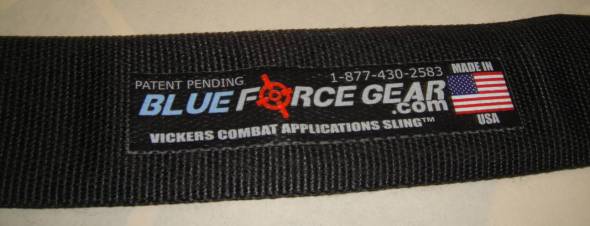
The Vickers Combat Application Sling is designed and marketed toward police, military and civilian shooters using modern, ergonomic long arms such as the AR-15 and other similar platforms. The sling is intended to provide a secure means to carry a rifle across the front of the user’s body in a hands free condition, allowing other tasks to be completed without needing to constantly hold onto the firearm.

BFG's VCAS

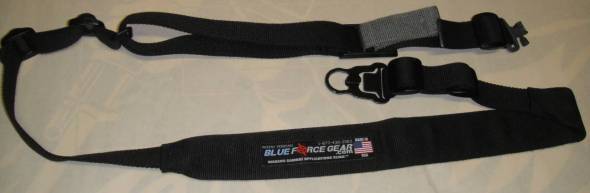
Vickers Combat Application Sling

The particular model of rifle sling chosen for this review is padded with polymer hardware. Non-padded versions are available for lower cost. Also aluminum hardware is available in both padded and non-padded versions.

VCAS-2

The connection points need to be purchased to the user’s rifle specifications

It should be noted that VCAS sling comes without attachment hardware. Those in the picture above were purchased specifically for use with the reviewer’s rifle. Attachment points and methods on modern, ergonomic competitive sporting rifles vary and the user free to select what works best for them and their equipment. If the user does not want or need a quick release method of attachment, they can simply loop the straps at the ends of the sling through available fixed attachment points that are common on these rifles and attach the sling this way with no extra hardware needed. This means the purchaser is not stuck paying for attachment hardware that they won’t use.

Initial examination of the sling shows that it constructed of heavy 1 ¼ inch nylon webbing. The polymer hardware is relatively thick and is of durable construction. Obviously the aluminum hardware would be even stronger but after discussing with a college who has military experience, the polymer would likely be preferred to reduce sound when the hardware comes in contact with the rifle and other gear. Not that important to the civilian shooter but if polymer hardware is good enough for the military; it is good enough for me.

The sling has three points of adjustment to suit the rifle and user. The upper most section, attached to the rear of the rifle as well as the middle section are designed as “fixed” adjustments. These are set by the user and are not quickly adjustable.

Adjusting the VCAS

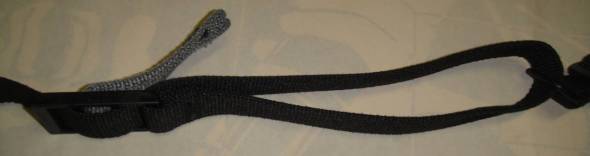
The quick adjust pull handle allows for a rapid shortening or lengthening of the sling depending on the user’s need.

The front section contains a quick adjustment pull handle (shown above) that allows the user to quickly lengthen (and re-shorten) the sling as needed. Following provided directions, the upper and middle sections are to be adjusted to set the overall length of the sling with the front section in the “closed” position. This allows the rifle to be securely hung across the length of the user’s torso. The front section can then be opened to allow for easier weapon manipulation such as switching to the weak side shoulder. This also facilitates moving to the prone position while maintaining the muzzle in a safe, down range direction. The adjustment method is unique in that once the position of the front section is set, it stays in place and does not move on its own. Other quick adjust slings that I have tried have proven to “have a mind of their own” when it comes to quick adjustments and simply won’t stay set.

The VCAS in “action”

Initial testing of the sling was conducted at a local rifle range and frankly my first impressions were not favorable. The sling limited rifle manipulation, magazine changes, safely adopting a prone position and utilizing a pistol with the rifle slung. For the latter point, the sling rifle hung very high with the butt resting in front of the shooters shoulder. This made extending the arms for proper pistol shooting difficult.

Further trials showed that I simply had the sling adjusted too tightly. Once the middle section was adjusted to provide more overall length the sling performed very well. Leaving sufficient slack in the sling allowed for interference free reloads and no longer obstructed pistol shooting as the rifle hung below the shooters shoulder.

Recently the VACS was “fielded” in completion at an Ontario Rifle Association Close Quarters Battle (CQB) match. Frankly, it worked flawlessly. Walking around the range with a slung rifle was effortless and left two hands free for organizational tasks such as scoring, patching of targets and even a bit of range tear down. Magazine changes were not impeded and neither was pistol shooting. Walking around the range with a 20 inch barreled AR did not result in any banged shins, knees or other anatomical regions. The quick adjust front section allowed easy adoption of the prone position while keeping the muzzle pointed directly down range.

The VCAS in use

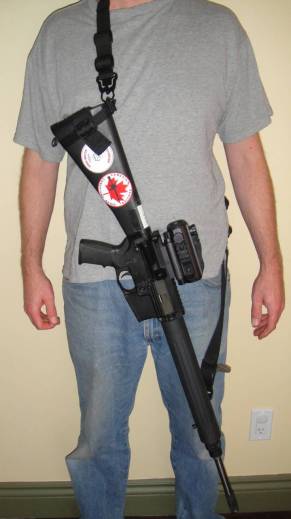
The VCAS being utilized.

A note about use of this and other two point slings. The selected attachment points at the front and rear of the rifle were generally on the side closest to the shooter. This allows the tension of the sling to hold the rifle flat against the body. Attachment at more conventional bottom of rifle points would tend to cause the rifle to tip over when slung and perhaps end up with the rifle hanging in an upside down orientation.

Further, the sling was wrapped over the strong side shoulder and under the weak side one, so that when the rifle is left to hang, it does so in a generally muzzle down direction so that bystanders are not swept by the muzzle.

Other uses of the VCAS

While targeted at modern style semi-automatic long arms, the VCAS would be an effective for hunting arms as well. By establishing attachment points on the side of the rifle, any style can be slung in the same fashion. For hunters negotiating think brush and climbing difficult terrain, this sling configuration will allow two hands to remain free while walking and maintain the rifle in an easy to reach position should game appear suddenly and a quick reaction is the difference between meat in the freezer and a tale of one that got away.

Further, by changing the method of adjustment, the quick adjust front section could be set such that tightening it “locks” the rifle to the shooters body, keeping it even more tightly secured to the shooters chest and or enabling it to be switch to lay across the hunters back and locked when “out of the way carry” is needed.

The Verdict

Retailing at $62.99 at One Shot Tactical Supply, the Blue Force Gear VCAS padded sling is not going to be the lowest cost option for a two point sling, but it is a quality piece of kit that does what it intends and does it well. The non-padded version retails for $52.99 while the option of aluminum hardware adds $20.00 to the cost of either version. The quick adjust front portion sets the VCAS apart from many other offerings and is a very useful feature. Based on the overall quality of the slings construction I am sure this piece of kit is going to last for years to come.

As the reviewer I purchased this sling with my own cash as a means to try it out after hearing lots of hype. I figured I can always sell it for a small loss if I didn’t like it. Well, this particular VCAS sling is NOT for sale. I think that sums up my impression of this sling most effectively.

Submitted by: Bryan Bolivar, Canadian Service Conditions Radio

Again, thanks to Bryan Bolivar for his submission on the BFG – VCAS. For the readers notes, One Shot Tactical Supply is located in Trenton, Ontario and also has an online presence. As always it is up to our readers to determine if this piece of equipment is Tactical, Practical, or Fantastical for themselves.

October 31st, 2012 – Halloween to most, yet millions celebrate for a different reason!

The resounding answer by firearms owners across Canada? Hell Yes! As of October 31st, 2012 it is official. Canada has finally rolled back a small piece of the great white elephant called C-68. The long gun registry, that is the registration of non-restricted firearms, has finally been completed. At least everywhere but the province of Quebec.

On May 2nd, 2011, Canadian elected a majority Conservative government which had as one of it’s campaign promises, to scrap the ineffectual long gun registry. Eleven months later on April 5, 2012, Bill C-19 received royal assent and the official end to the registration of NR firearms began. It is only now, another 7 months later that the actual records themselves are being destroyed, but not until after many many attempts by bureaucracy to subvert the intent of the new legislation.

Lets see a time line of the trials and tribulations which trying to stymie the process.

  • February 2012 – House of commons votes on third reading and Bill C-19 passes to the senate with the vote 159-130.
  • April 2012 – Senate votes on Bill C-19, it passes with the vote 50-27
  • April 2012 – Quebec files an injunction to preserve registry data for Quebec non-restricted firearms
  • April 2012 – Bill C-19 receives royal assent
  • May 2012 – Chief Firearms Offices try and argue that C-19 only means omission of recording registration ID numbers of firearms and attempts to keep enforcing filling of all other data into the CFO registration ledgers by businesses via business licence requirements.
  • June 2012 – Government enacts legislation to prevent recording of ANY personal information as part of conditions of a firearms business licence.
  • August 2012 – Barbra Schlifer Commemorative Clinic applies for injunction of data deletion and to have C-19 ruled unconstitutional and stricken from law
  • Sept 2012 – Quebec courts uphold injunction for Quebec “data”
  • Sept 2012 – Barbra Schlifer Commemorative Clinic case thrown out of Ontario court
  • Oct 2012 – The files are officially deleted on Halloween

Now those that actually read the list will note that there currently is not a resolution in Quebec yet. The registration data is still being recorded in Quebec. This is obviously the sore point in the whole resolution of Bill C-19 and total destruction of all things regarding non-restricted firearm registration. The current federal government has vowed to take the Quebec challenge to the highest levels of court to have the data deleted on par with the rest of Canada, however it will take time because the wheels of Canada’s legal system are unfortunately slower than pouring frozen molasses.

CSSA/CILA’s Tony Bernardo

So what does this mean? For 9 Provinces and 3 Territories, the “Long Gun Registry” has finally been laid to rest. Kudos to the hard work put forwards by dedicated individuals such as Tony Bernardo, MP Garry Breitkreuz, all the staff and volunteers of the Canadian Shooting Sports Association and of course thanks to all of you! The firearms owners of Canada who have helped with volunteer efforts, donations, writing letters, talking and interacting with political figures, spending their valuable time and energies focused on one goal, to improve the laws regarding firearms for responsible shooters.

We at TPF congratulate ALL those who have helped, from donations of pennies to shouldering the  running of trade shows. Without your efforts all of what we do would be impossible. HOWEVER! We cannot stop here, there are far more things that need to be done and changes to be made.

One small step for repealing bad gun laws, one giant leap for crushing ridiculous gun control agendas!

Bear Grylls Survival Kit – Is it really the ultimate?

For many readers, the name Bear Grylls may sound somewhat familiar. If you watched a fair amount of outdoors featured television programs, you may have come across the show Man versus Wild. Man versus Wild ran from mid-2006 until late-2011 and starred Edward Michael “Bear” Grylls who demonstrated various survival techniques and theoretical situations and various methods of resolving those problems. Gerber Legendary Knives has collaborated with Bear Grylls in launching a survival series of products which are purportedly for aiding outdoorsmen during their foray’s into the wilderness. In today’s installment of TPF, The Ultimate Kit of the Gerber/Bear Grylls survival series is reviewed.

Image1

According to Gerber and Bear Grylls, this small bag contains the essentials for an EDC emergency survival kit.

The first thing you will note is the bag the kit comes in itself. manufactured from a lightweight black nylon material which has additional heavy reinforcement threads, a.k.a. Ripstop weaving, to help resist tearing and ripping, and prevent the expansion of small tears which may occur. The zipper closure is classed as being waterproof, but there is a very small gap in the teeth obvious when the zipper is fully closed, which visually seems to void this claim. The author did not however actually test the waterproof claim so it MAY be true.

The two most identifiable and visible items that are seen is the lanyard whistle attached to the zipper and the Land-to-Air rescue instructions which are located on the backside of the bag. With All the various components still packed inside, the bag measures roughly 170mm x 120mm x 40mm (6.7″ x 5.5″ x 1.6″) and masses roughly 280 grams (9.0 oz). From the Gerber factory, all the components are contained inside a waterproof zip-loc transparent bag, which is manufactured from extra thick materials. The author was quite impressed with the sheer volume of items contained, but TPF will allow the readers to judge the individual components as being worthwhile for inclusion in the Ultimate Kit.

BG_SP-02

Inside the waterproof bag is where all the survival necessities are located

TPF will go through the list of items contained in the Ultimate Kit for the Survivor Series line.

  1. Waterproof Ziplock Bag – The container that all inner tools come packaged inside.
  2. Miniature Light – A key chain mountable LED light
  3. Hand Saw – A metallic cable saw with pull rings on both ends
  4. Emergency Whistle – Larger than the lanyard whistle, more range and louder
  5. Signaling Mirror – A small mirror for reflecting signals and instructions on use
  6. Survival Blanket – A space blanket made of mylar and used for reduced heat loss
  7. Fire Starter – With a steel striker connected to a ferrocerium rod on a short lanyard
  8. Waterproof Matches – Quantity of eight (8), with an abrasive ignition strip
  9. Cotton Ball – Tinder for starting fires
  10. Snare Wire – Approximately 305mm (12″) of brass wire
  11. Emergency Cord – Roughly 2.4M (8′) of white braided nylon cord
  12. Waxed Thread – A small spool of heavy thread, unknown length
  13. Fishing Kit – A small quantity of fishing line with four sets of hooks, split sinkers, and swivel clevises
  14. Sewing Kit – Black, white, red, and gray threads, needle, and a black and white button
  15. Pocket Guide – Priorities of Survival, basic information book on survival
  16. Multi-tool – Gerber Clutch
    • Needle nose pliers, wire cutter, small knife blade, nail-file, trio of small screwdrivers, bottle opener, tweezers, lanyard ring
BG_SP-03

The contents spread out for display. The Ultimate Kit does have a whole slew of useful survival gear

For this review, none of the items were removed from their packaging and approximations were made about lengths, but it is impressive to see just how much one is able fit into the small bag. There are some very nice and well thought out items in this package such as the cotton ball tinder and the brass snare wire, but at the same token, why is there so little of them? You could easily hold two to three times the quantity of snare wire, cotton balls, fishing line, etc.. without worrying about internal space constraints or cost extras. Readers should be aware that this kit is not intended to be a long-term survival kit, which would be much larger and include greater quantities of items as well as items such as a water purification system, first aid kits, etc… The Ultimate Kit is literally for a small EDC style carry for those who are not stereotypical “Survivalists” and in this it succeeds remarkably well.

The Bear Grylls Survivor Series Ultimate Kit is offered by Gerber Gear at an MSRP of $52 USD, and can be found at numerous stores across Canada such as Cabela’s in Winnipeg, Manitoba. As always, it is up to the reader to have their own say on if the Ultimate kit as reviewed is Tactical, Practical, or Fantastical?

An interesting take on an EDC multi-Tool. Is it all you truly need?

Sometimes a product comes around that defies TPF’s standard conceptual understanding of what that product’s generic style should entail or encompass. It is a very rare event however. Yet Kershaw knives has done exactly that with their off beat multi-tool, the Select Fire.

SelectFire-01

Select-Fire multi-tool

Kershaw Knives are not unknown to many readers, but there are a few who have never heard of this company.  Kershaw Knives was founded in 1974 in Portland, Oregon when knife salesman Pete Kershaw started a cutlery company that would make knives from his designs. Those designs were manufactured by Japanese based KAI Cutlery. In 1978, KAI Cutlery purchased Kershaw Knives and the overall company was renamed KAI USA Ltd. KAI USA continues today with three product lines; including the original Kershaw Knives and Shun Cutlery which primarily markets kitchen cutlery. Fast forward to 1998, and after nearly 25 years of knife design and manufacturing, Mister Pete Kershaw, then company president, retired with a corporate legacy of good quality products for value and a superb customer service program, which continue to this day.

Most common every day carry multi-tools are based primarily around a set of pliers with accessory tools and blades as secondary components of the tool. In this EDC product there are simply two tool arms with a couple additional features added in. If one was to ask what is comparable to this product, the first idea that popped into the author’s mind was an older, simple swiss-army tool. What makes it similar to that well-known and house-hold description? The first thing that is noticeable about the Kershaw Select Fire is that is first and foremost a folding knife with some additional tools added in for when they are required. This is where the difference in EDC multi-tool design philosophy is apparent. Is it more desirable to have a dedicated tool with a blade being secondary, or is a blade the primarily used part and other items are secondary.

SelectFire-02

Kershaw’s Select-Fire is a knife first and foremost, but it does have some extra features

SelectFire-04

Smooth design and blade secured via a liner-lock

As stated, the Select Fire is designed around a 86.0mm (3-3/8″) spear-point profile blade. Manufactured from 8Cr13MoV steel and having a satin finish, the non-serrated blade incorporates both a slight hollow grind and re-curve edge in its design. Mounted in the 3.1mm (1/8″) wide spine are a pair of opposed thumb studs for ambidextrous opening. The blade itself is nestled between a set of steel liners, one of which has the liner locking mechanism for ensuring a securely extended position. The glass-filled nylon panels are moulded in black with a fish bone shaped pattern on them. Secured to the liners via a series of hex socket rounded head screws on each side, the panels are comfortable even when using the secondary tool arm of the Select Fire.

The secondary tool in this design is an extendable 6.4mm (1/4″) hex bit driver which has three positions retained by a small spring-loaded bar. Available are the closed, 90° (half) and 180° (full) extended positions. Roughly 64.0mm (2-1/2″) in length, the bit driver turns the multi-tool into a true screwdriver with minimal profile changes to the main handle of the Select Fire. The author has not tested the durability of the driver arm, but the main shaft is rectangular in section 3.1mm x 4.8mm (1/8″ x 3/16″) and seems to be very sturdy. Like most bit drivers however, the usefulness is limited without the actual drive bits themselves. This is where the design of the Select Fire takes a turn to modern methods and ideas.

SelectFire-03a

Pre-loaded with four bits, the Select-Fire is innovative in it’s bit storage and in turn it’s construction

SelectFire-03

Bit driver fully deployed

Most multi-tools which have some sort of screwdriver tool arm have very short malformed driver heads and are very hard to manage as a useful screwdrivers. For those multi-tools that incorporate a bit driver attachment, the actual bits are sometimes miniaturized and/or proprietary and once lost are expensive to replace. The other multi-tools which use full-sized bits have an additional pouches, sleeves, or external holders to ensure that your bits are nearby when you want them. The Select Fire solves the storage problem in a simple and ingenious method. It stores full-sized driver bits in the handle, two per side. A cutout in the liners and grip panels serves as the home to a small, spring-loaded, bit holder on each side. Each bit holder holds two bits between three “fingers” which incorporate the hexagonal shape of the bit shanks themselves. The Spring loaded holders snap back into storage position, which does not allow a full size bit to fall out of the holder due to the limits of the aforementioned cutouts in the liner and grip panels. The Select Fire comes pre-loaded with #5 and #7 straight-style bits, and PH1 and PH2 Philip head bits. However, the true benefit of the use of full-sized bits is that the end-user can replace them with anything which is more commonly used such as red #2 Robertson or such.

SelectFire-05

Spring loaded to retract into the handle, the storage arms keep bit handy and immediately nearby

These are the primary and secondary tool components of the Select Fire multi-tool. A large dedicated blade and a dedicated bit driver. The design does incorporate a couple tertiary design features which, in the author’s opinion, are more akin to small design quirks to add to tool count. These are a small ruler on the bit driver arm, and the bottle opener which is incorporated into the recess for the bit driver and requires the driver be extended before usage in both cases. The Select Fire has a reversible pocket clip which allows it to be worn in the tip-down position. Considering the overall closed size of 108.0mm (4-1/4″) and mass of only 152 grams (4.8oz), the Select Fire is a very easy addition as an EDC for anyone who prefers this style of multi-tool. Blade focus versus plier focus.

Overall it is well made and, as per most Kershaw products, has a good design and quality for the price. The ONLY detraction the author has is the slight chance that the bit holder springs may protrude just enough to snag on finer materials, but the Select Fire isn’t meant for dressy occasions, so that sort of event may never occur.

Kershaw Knive’s Select Fire, model #1920, has an MSRP of $34.95 USD and can be obtained from retailers such as Gorilla Surplus, located at 1458 Broadway E., Vancouver, BC. Like every product reviewed by TPF-Online, it is up to you the reader to decide if the Select Fire is  Tactical, Practical, or Fantastical…

The personal shield to help protect, according to SOG Knives

SOG_Aegis-01

SOG’s Aegis

SOG speciality Tools and Knives is renowned for their geared plier-based multi-tools, but as per previous installments of TPF-Online, they also manufacture some quality and interesting blades. With that being said, SOG gratefully provided TPF-Online with one of the Aegis line of knives for reviewing. For those that may wonder where the word Aegis comes from, let us take a bit of a history lesson from Wikipedia.

An aegis is a large collar or cape worn in ancient times to display the protection provided by a high religious authority or the holder of a protective shield signifying the same, such as a bag-like garment that contained a shield. Sometimes the garment and the shield are merged, with a small version of the shield appearing on the garment. It originally was derived from the protective shield associated with a religious figure when related in myths and images. The wearing of the aegis and its contents show sponsorship, protection, or authority derived from yet a higher source or deity. The name has been extended to many other entities, and the concept of a protective shield is found in other mythologies, while its form varies across sources.

SOG_Aegis-02a

The Aegis has a slimmer handle than the similar Flash-II. Both are SAO knives but there are some subtle differences between the two

The word Aegis has traditionally been used in defensive systems and designs across the world, from protective sunglasses to 1911 style handguns to ship based missile systems. It is in this vein of thought that SOG has adopted the name’s usage for an ultralight folding knife series. Based upon the patented SOG Assist Technology™, and the Arc-Lock system, the Aegis is very similar to the previously reviewed Flash-II in opening, locking, and safety mechanisms. TPF-Online takes a look at the AE-04 model of the Aegis series of knives.

SOG_Aegis-04

The Aegis handle has no steel liners securing the blade malking for a lighter design

The initial thought of the author when the Aegis was first looked at was that the handle looked cheap with a bland matte black finish and very minimal patterning for grip retention. Simply put however, the author was wrong. The black handle of the knife is manufactured from Zytel nylon and is composed of 2 halves secured together with six (6) socket head screws. Four (4) along the back spine of the handle, one (1) for the pocket clip, and final fastener as part of the SAT/pivot.  The partially serrated tanto blade measures 89.0 mm (3.50″) in length and inserted into the blades spine are the ambidextrous thumb studs. The titanium nitride coated AUS-8 steel blade sports nearly 28.0 mm (1.10″) of thumb ridges along it’s 3.0 (0.12″) thick spine.

SOG_Aegis-05

Showing off Gerber’s Serration pattern

The Aegis handle does differ from the Flash and it is these differences which externally show up between the two designs. The profile of the Aegis removes any excess thickness and width which was present on the Flash-II’s, such as the removal of the lanyard loop hole, two finger profile in the grip, and the small hump at the top of the handle above the pivot. The mass saved is offset by the tanto-blade profile which, while massing the same 97 grams (3.1 oz) as the Flash-II, results in the Aegis having a centre of gravity further forward than the Flash-II.

In the grips are a series of rubberized inserts sporting the SOG brand name repeatedly while proving a surer gripping ability for the individual whom wields the knife. The manual safety on the left side of the grips and prevents the Arc-Lock system from moving the locking piston when in safe position. Since the piston lock also provides direct resistance for initial blade opening, by engaging the safety the piston is rendered immobile and therefore disables opening of the blade. Add into that the reversible pocket clip for tip-up carrying, and the Aegis package is complete. While SOG promotes this product as a tactical knife, the low mass and efficient blade design make the Aegis a good EDC knife for those interested.

SOG_Aegis-03

Just above the rubber grip inserts, the safety of the Aegis shows that the blade is deployable

The SOG Aegis reviewed (AE-04) has a MSRP of $114.00 USD and is one of many variations available for the Aegis line of blades. Remember that the SOG AE-04 Aegis Folding Knife, like all SOG products, is backed by a lifetime warranty that protects against defects in manufacturing and materials. This knife can be found as various stores across Canada and online at places such as Toronto based www.thegreatoutdoorsmen.ca. TPF-Online authors have their own opinion of the Aegis folding knife, but ultimately it is your decision, the reader’s, to determine if SOG’s Aegis folding knife is Tactical, Practical, or Fantastical.